The map app said I was at my destination. I looked around. Nothing.
Then I looked up. The hotel lobby was three floors above me.
Welcome to Chongqing, where GPS goes to die and gravity is more of a suggestion than a rule.
Forty-eight hours later, I stood in front of a lake so blue it looked fake. The water was so clear I could count the branches of a tree that had been underwater since the Ming Dynasty.
My brain couldn’t process it. My camera couldn’t capture it.
That’s Jiuzhaigou. And somehow, these two places exist in the same corner of China.
Here’s what nobody tells you: most travelers pick one. City or nature. Concrete or trees. Noise or silence.
That’s like going to Italy and only eating pasta or only seeing art.
You don’t have to choose.
Think of It Like This
If China were a meal, Chongqing would be the Sichuan peppercorn—numbing, intense, unforgettable. Jiuzhaigou would be the purest mountain spring water you’ve ever tasted—clean, quiet, humbling.
One shocks your senses. The other resets them.
Together, they’re the perfect trip.
Chongqing: The City That Shouldn’t Exist
I’ve been to Tokyo. New York. Shanghai. None of them prepared me for this.
Chongqing is built on mountains. Roads stack on top of roads. A monorail punches through an 18-story apartment building because, apparently, that was the easiest solution.
Locals call it the “8D city.” After three days, I stopped trying to understand what that means. I just accepted that up is sometimes down, and the first floor might actually be the tenth floor.
The Night Scene Will Break Your Camera
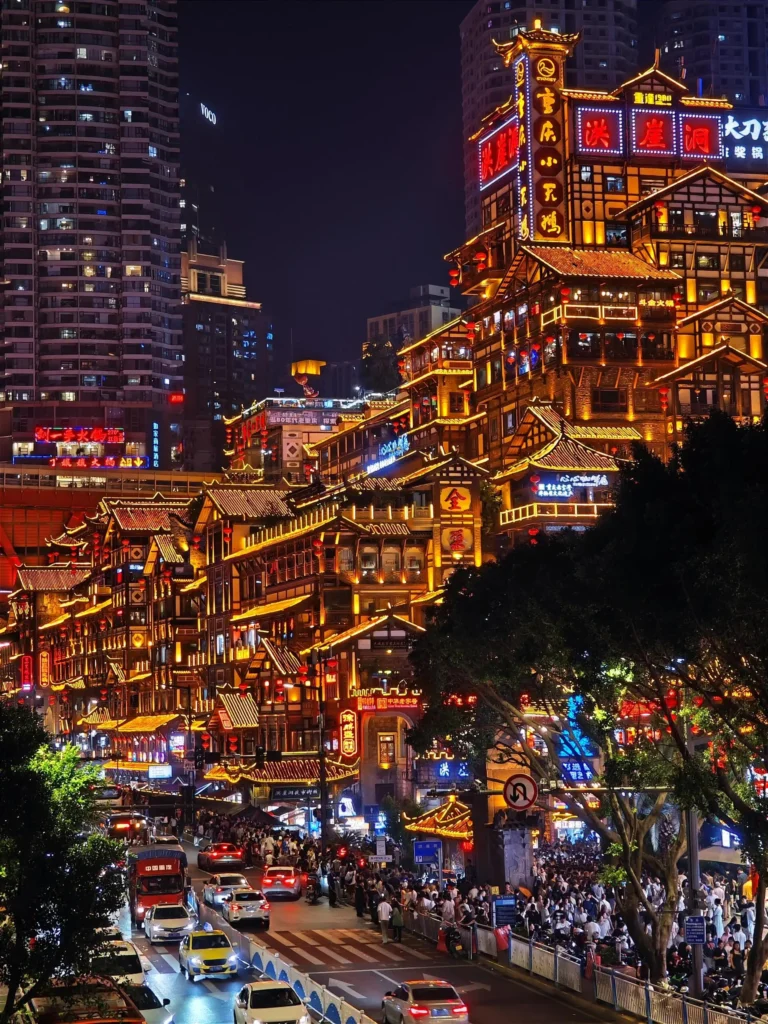
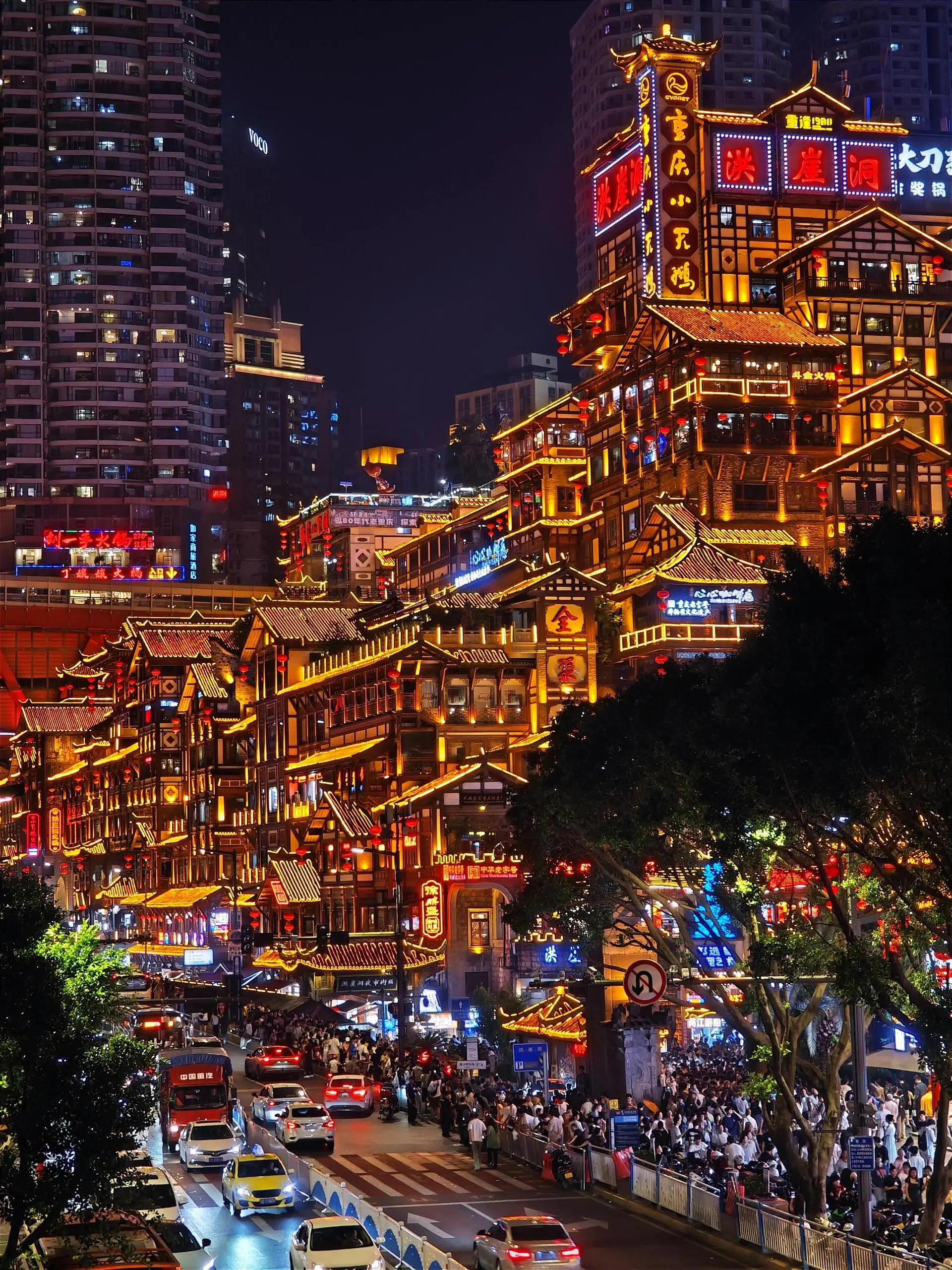
At night, Hongya Cave lights up like someone pressed “cyberpunk” on a remote control.
Traditional stilt houses cling to a cliffside, glowing gold. The Jialing River reflects it all. Tourists crowd the walkways, phones out, mouths open.
I get it. I took forty-seven photos. Deleted forty-six of them. None captured what my eyes were seeing.
When to go: Night, obviously. 7-9 PM is prime time.
How much: Free to walk around. Budget $15-30 for food and drinks while you’re there.
The Food Is a Contact Sport
Let’s talk about hotpot.
Chongqing hotpot isn’t dinner. It’s an experience. It’s a challenge. It’s a war of attrition between your taste buds and your pride.
The broth is red. Not tomato red. Demon red. Floating chili peppers. Numbing Sichuan peppercorns that make your lips tingle for hours. You dip beef, tripe, lotus root, duck intestine—count to three, pull it out.
First bite: “Oh, this isn’t so bad.”
Tenth bite: “I can feel my soul leaving my body.”
Twentieth bite: “More, please.”
Pro tip: Order the “yuanyang” pot—half spicy, half mild. It’s the diplomatic solution to a very spicy problem.
How much: $20-40 per person for a proper hotpot meal. Yes, you can spend more. No, you don’t need to.
What to See (and How Much It Costs)
| Attraction | Time Needed | Cost | Notes |
|---|---|---|---|
| Hongya Cave | 2-3 hours | Free | Go at night |
| Liziba Station | 30 minutes | Free | Train goes through building |
| Ciqikou Ancient Town | 2-3 hours | Free | Go early, before 10 AM |
| Jiefangbei | 2-4 hours | Free | Shopping, food, people-watching |
| Yangtze River Cableway | 30 minutes | $3 | Views of the river |
Three days is the sweet spot. Enough to get lost (you will). Enough to eat too much (you will). Enough to fall in love with the chaos (you will).
Jiuzhaigou: Where Nature Shows Off
If Chongqing is what happens when humans go wild with architecture, Jiuzhaigou is what happens when nature goes wild with water.
The numbers:
– 108 alpine lakes
– Waterfalls you can hear from a kilometer away
– Forests that turn into fire in autumn
– Snow-capped peaks staying white year-round
– Elevation: 2,000-4,500 meters (6,500-14,700 feet)
But numbers don’t do it justice. Nothing does.
The Lakes That Don’t Make Sense
Five Flower Lake is the crown jewel. The water shifts color as you walk around it—turquoise, sapphire, emerald, amber.
Scientists will tell you it’s mineral deposits and algae. I say it’s magic.
At the bottom, ancient tree trunks lie preserved in crystal-clear water. They’ve been there for centuries. They’ll be there for centuries more.
You’ll stand at the railing. You’ll take a photo. You’ll delete it because the photo is an insult to what your eyes are seeing.
Long Lake sits higher up, surrounded by mountains. It’s quieter. More serious. Like the wise elder to Five Flower Lake’s show-off teenager.
The Waterfalls That Roar
Pearl Shoal Waterfall is 160 meters wide—water cascading over a calcified shelf. The mist hits your face. The sound drowns out your thoughts.
This is where they filmed Journey to the West, the classic Chinese TV series. Once you see it, you understand why.
Tibetan Culture, Still Alive
Jiuzhaigou means “Nine Village Valley.” Nine Tibetan villages once dotted these mountains. Some are still here.
You’ll see prayer flags strung between trees. Wooden houses with carved balconies. Locals selling yak butter tea and handmade jewelry.
This isn’t a theme park. People live here. Their ancestors lived here for a thousand years.
What to See (and How Much It Costs)
| Attraction | Time Needed | Cost | Notes |
|---|---|---|---|
| Park Entrance | Full day | ~$45 peak / ~$30 off-peak | Includes bus (280/170 RMB) |
| Five Flower Lake | 1-2 hours | Included | The jewel |
| Long Lake | 1-2 hours | Included | Highest lake |
| Pearl Shoal Waterfall | 1 hour | Included | Bring a rain jacket |
| Zechawa Valley | Half day | Included | Less crowded |
Two full days in the park is ideal. One day if you’re rushed. Three if you want to photograph everything.
The Perfect 7-Day Route
Here’s exactly what I’d do:
Days 1-3: Chongqing
- Day 1: Land, check in, recover from jet lag. Hit Hongya Cave at night. Eat something light (your stomach needs to warm up).
- Day 2: Hotpot for lunch (start mild). Liziba Station in the afternoon. Ciqikou Ancient Town before dinner. More food at night (yes, really).
- Day 3: Jiefangbei shopping. Last bowl of noodles. Fly to Jiuzhaigou (1.5-hour flight, ~$150-250).
Days 4-6: Jiuzhaigou
- Day 4: Arrive, rest, acclimate to altitude. The park is at 2,000-4,500 meters. Take it easy. Drink water. No alcohol.
- Day 5: Full day in the park. Rize Valley in the morning (Five Flower Lake, Pearl Shoal). Shuzheng Valley in the afternoon.
- Day 6: Zechawa Valley. Long Lake. Five-Color Pond. One last look at the impossible water.
Day 7: Fly home
Or extend. Add Chengdu (2 hours from Chongqing). See the pandas. Eat more food. (Always eat more food.)
When to Go
Chongqing:
– Best: Spring (March-May) or fall (September-November)
– Avoid: Summer (brutally hot, 100°F+) and winter (foggy, gray)
Jiuzhaigou:
– Best: October (fall colors are insane)
– Also great:
– Spring (April-May): Waterfalls at full flow, flowers
– Summer (June-August): Cool escape, green everywhere
– Winter (November-March): Frozen waterfalls, snow, fewer tourists
Can you do both in one trip? Yes. Same region (Southwest China). Same best season (fall).
The Logistics Americans Need to Know
Visa
- Required: Yes, Americans need a Chinese visa
- Processing time: 4-7 business days (expedited available)
- Cost: ~$140-200 depending on processing speed
- Tip: Start the process at least 3 weeks before your trip
Flights
- To Chongqing: Direct from LA/SF (seasonal), or via Shanghai/Beijing
- Chongqing to Jiuzhaigou: 1.5-hour flight, ~$150-250
- Total flight time from US: 14-18 hours including connections
Money
- Currency: Chinese Yuan (CNY)
- Payment: WeChat Pay and Alipay are everywhere. Cash is less common.
- Tip: Set up WeChat Pay or Alipay before you go. Link your US credit card.
- Budget: $80-150/day for food, transport, attractions (not including flights/hotels)
Internet
- Blocked: Google, WhatsApp, Instagram, Facebook, YouTube
- Solution: Get a VPN before you arrive. Install it on your phone and laptop.
- Alternative: Buy a Chinese SIM card with international data (China Unicom works best)
Language
- English spoken: Limited, especially in Jiuzhaigou
- Apps to download: Pleco (dictionary), Google Translate (download offline packs)
- Tip: Learn a few Mandarin phrases. “Xiexie” (thank you) goes a long way.
Health & Safety
- Altitude: Jiuzhaigou is high (2,000-4,500m). Take it easy Day 1. Drink water. Consider Diamox if you’re worried.
- Safety: Both places are very safe for tourists—even solo travelers. Standard precautions apply.
- Travel insurance: Recommended. Make sure it covers altitude-related issues.
- Jet lag: Chongqing is 15-16 hours ahead of US East Coast. Plan 1-2 days to adjust.
Hotels
- Chongqing: $50-150/night for good mid-range. $200+ for luxury.
- Jiuzhaigou: $40-100/night near the park. Book in advance for fall season.
The Real Question
Why Chongqing and Jiuzhaigou together?
Because most trips are either about places or experiences. This is both.
You’ll leave Chongqing with a sore throat from laughing too much and a numb tongue from eating too much spice.
You’ll leave Jiuzhaigou with a camera full of photos that don’t do it justice and a quiet mind.
One trip. Two worlds.
Here’s the truth: The city will shake you awake. The mountains will teach you to breathe again. You’ll come back different—not just with photos, but with a new rhythm in your head.
That’s the deal.
Quick Budget Breakdown (Per Person, 7 Days)
| Category | Budget | Comfort | Luxury |
|---|---|---|---|
| Flights (US-China) | $1,200-1,800 | $1,500-2,200 | $2,500+ |
| China domestic flights | $200-300 | $200-300 | $400+ |
| Hotels | $250-350 | $500-800 | $1,200+ |
| Food | $150-250 | $300-500 | $700+ |
| Attractions/Transport | $300-400 | $300-400 | $500+ |
| Total | $2,100-3,100 | $2,800-4,200 | $5,300+ |
I went to China thinking I’d pick one destination. I’d do the city or the mountains.
I was wrong.
Chongqing and Jiuzhaigou together? That’s the trip.
Book it. Your future self will thank you.