
From August 8 to 9, 2017, two major earthquakes struck western China: a magnitude-7.0 earthquake in Jiuzhaigou, Sichuan Province, and a magnitude-6.6 earthquake in Jinghe, Xinjiang Uygur Autonomous Region. The consecutive occurrence of strong earthquakes in a short period has raised concerns: Has China entered a period of high seismic activity? Can reservoirs trigger major earthquakes?
On August 11, reporters interviewed Chen Houqun, an academician of the Chinese Academy of Engineering, and Liu Jie, deputy director and researcher of the China Earthquake Networks Center. The experts stated that China’s seismic activity remains at a normal level.
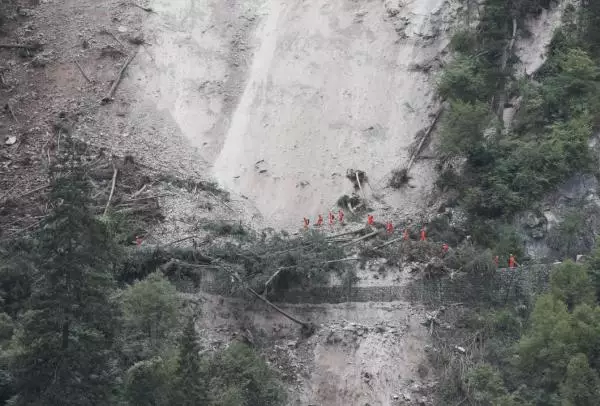
On August 10, a search and rescue team passed through a landslide section from Wuhua Lake to Panda Lake in the Jiuzhaigou Scenic Area. (Photo by Xinhua News Agency)
Has China Recently Entered a Period of High Seismic Activity?
Historically, consecutive strong earthquakes within a short time frame have occurred before. For example:
- On April 14, 1955, a magnitude-7.5 earthquake hit Kangding, Sichuan, followed by two magnitude-7.0 earthquakes in Wuqia, Xinjiang the next day.
- On March 6, 1966, a magnitude-6.6 earthquake struck Zanda, Xizang, and a magnitude-6.8 earthquake hit Longyao, Hebei on March 8.
- On October 5, 2008, a magnitude-6.8 earthquake occurred in Wuqia, Xinjiang, and a magnitude-6.6 earthquake struck Damxung, Xizang on October 6.
Thus, consecutive strong earthquakes are not rare.
China has a relatively high level of seismic activity, with an annual average of 20 magnitude-5 earthquakes and 3 to 4 magnitude-6 earthquakes. According to Liu Jie, before the magnitude-7.0 Jiuzhaigou earthquake, the Chinese mainland had seen a 24-month lull in magnitude-7 earthquakes and an 8-month lull in magnitude-6 earthquakes. Only four magnitude-5 earthquakes occurred between January and July 2017, indicating a relatively low level of seismic activity.
Liu Jie pointed out that the two recent earthquakes compensated for the previous low seismic activity, and China is still in a normal seismic state.
He added that magnitude-7 earthquakes are common in China, occurring twice every three years on average. Based on seismic data since 1900, China’s seismic active periods are defined by major earthquakes of magnitude 7.5 or earthquake swarms of magnitude 7, such as the 1920 magnitude-8.5 Haiyuan earthquake in Ningxia, the 1988 magnitude-7.6 Lancang earthquake in Yunnan, and the 2001 magnitude-8.1 Kokoxili earthquake. The magnitude-7.0 Jiuzhaigou earthquake falls within China’s normal seismic activity.
What Are Reservoir-Triggered Earthquakes? Can Reservoirs Cause Major Earthquakes?
Sichuan Province is rich in water resources and home to numerous reservoirs. Some public opinions have linked reservoirs to seismic activity recently. So what exactly are reservoir-triggered earthquakes, and can reservoirs trigger major earthquakes?
Chen Houqun explained that reservoir-triggered earthquakes fall into two main categories:
- After reservoir impoundment, existing karst caves or mine tunnels on both banks collapse due to water inundation, inducing small-magnitude earthquakes with limited energy within the reservoir area.
- The reservoir area crosses seismic fault zones. Water seeps underground after impoundment, increasing pore pressure and reducing shear strength, thus triggering earthquakes. These regions were already seismically active, and the reservoir only acts as a trigger.
Research on reservoir-triggered earthquakes began in the early 20th century. Most such earthquakes are small to moderate in magnitude and cause no major damage to reservoirs.
Chen Houqun noted that very few reservoirs have experienced earthquakes among all built reservoirs worldwide, and only four have seen reservoir-triggered earthquakes of magnitude 6 or above. The possibility of reservoirs causing major earthquakes is extremely low.
Is the Jiuzhaigou Earthquake Related to the Three Gorges Project?
Following the magnitude-7.0 Jiuzhaigou earthquake, online speculations linked the quake to the Three Gorges Dam. All interviewed experts clarified that the Three Gorges Project could not have triggered the Jiuzhaigou earthquake.
Chen Houqun stated that the epicenter of the Jiuzhaigou earthquake, at 33.20°N latitude and 103.82°E longitude, is near the Minjiang, Tazang, and Huya fault zones—an area inherently prone to earthquakes. The earthquake was caused by local strike-slip shearing as the northwestern Sichuan block was extruded by the northward push of the Indochina Plate.
Additionally, the dam site and reservoir area of the Three Gorges Project belong to the middle and lower Yangtze River seismic belt in the South China seismic region, which is in a different tectonic unit from the faults responsible for the Jiuzhaigou earthquake, with no tectonic connection between them.
The straight-line distance between Jiuzhaigou and the Three Gorges Project is approximately 700 kilometers, with impermeable strata in between, meaning no hydraulic connection exists between the reservoir water and the tectonic zone of the Jiuzhaigou earthquake. Extensive demonstrations were conducted before the Three Gorges Project was built, including assessments of potential reservoir-triggered earthquakes. The dam site itself is located on a stable tectonic block.
According to People’s Daily, Liu Jie explained that earthquakes are classified into tectonic earthquakes, induced earthquakes, volcanic earthquakes, collapse earthquakes, and artificial earthquakes. Reservoir-induced earthquakes occur when water seeps into rock fractures along large fault zones in reservoir areas, causing deformation and displacement. Such earthquakes are typically small in magnitude, shallow in focal depth, and limited in impact range.
“Large reservoirs may induce minor seismic activities, but these are confined to the reservoir and its surrounding areas, and cannot trigger earthquakes hundreds of kilometers away,” Liu Jie said. He emphasized that the Jiuzhaigou earthquake was a typical tectonic earthquake, caused by faulting and displacement of Earth’s rock layers due to geological tectonic movements. It differs fundamentally from reservoir-induced earthquakes in type and mechanism.