
A recent study on Schizopygopsis kialingensis from Jiuzhaigou has been published in the top international academic journal, Science Advances. The research was jointly carried out by the Jiuzhaigou Administration Bureau and Professor Li Jianzhen’s research group from the College of Life Sciences, Northwest Normal University. For the first time, the team uncovered the genetic mechanisms behind this Chinese endemic fish’s ability to thrive in Jiuzhaigou’s high‑calcium lakes. The findings offer new insights into vertebrate adaptation to extreme environments and mark a major scientific breakthrough for the Jiuzhaigou World Natural Heritage Site.
Native Residents of High‑Calcium Lakes
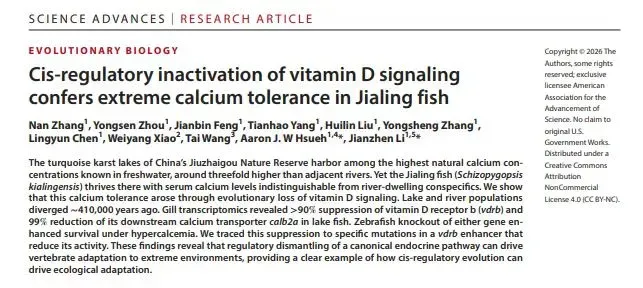
Tourists visiting Jiuzhaigou often spot small fish swimming in the crystal‑clear travertine lakes. This is Schizopygopsis kialingensis, a fish species endemic to China, found only in a small number of rivers and lakes across Sichuan and Gansu provinces. Jiuzhaigou’s karst lakes are calcium‑magnesium water bodies with extremely high calcium concentrations. Remarkably, Schizopygopsis kialingensis lives comfortably in this harsh environment, and its serum calcium levels remain comparable to those of river‑dwelling populations of the same species.
Five Years of Work: From Obscure Topic to International Breakthrough
Prior to this project, Schizopygopsis kialingensis in Jiuzhaigou had barely been studied. Only a few survey records existed, and almost nothing was known about its genetics. Professor Li Jianzhen’s team officially launched the research in 2021. At that time, very few relevant references were available worldwide. Starting from scratch, the team completed genome sequencing and assembly, population resequencing, gill transcriptome analysis, histological observation, zebrafish gene knockout and reporter gene assays, and many other experiments. After five years of continuous work from gene mapping to functional validation, the team fully decoded the genetic mechanism that allows the fish to survive high‑calcium conditions.
Evolution: Shutting Down Pathways, Not Gaining New Ones
The study shows that lake‑dwelling and river‑dwelling populations of Schizopygopsis kialingensis diverged hundreds of thousands of years ago. To cope with high calcium, the lake fish evolved in a surprising way: instead of developing new biological capabilities, it turned off a conserved regulatory pathway.
Specifically, expression of the vitamin D receptor b (vdrb) gene is strongly suppressed in lake populations, which in turn drastically reduces expression of the downstream calcium transporter gene calb2a. Further investigation identified that specific mutations in a regulatory region near the vdrb gene cause this suppressed gene expression.
The core implication: the fish’s adaptation to high‑calcium lakes did not arise from new functional innovations. Instead, it was achieved by losing a conserved regulatory pathway. In short, surviving extreme environments does not always require gaining new traits. Shutting down regulatory systems that become burdensome under new conditions can also be a viable evolutionary strategy. This discovery provides a fresh framework for understanding how other organisms adapt to extreme habitats.
Science Supports Conservation, Protecting Jiuzhaigou’s Wildlife
Supported by the Jiuzhaigou Administration Bureau, this project exemplifies integrated ecological conservation and scientific research. In recent years, Jiuzhaigou has continuously strengthened ecological monitoring and restoration. A routine monitoring system tracks meteorology, hydrology, water quality, atmospheric conditions, negative oxygen ions and more. In January 2026, the Sichuan Jiuzhaigou Wetland Station was officially included in the third batch of national comprehensive ecological quality monitoring stations. Jiuzhaigou has also been added to the IUCN Green List, boosting its platform capacity and global reputation.
Schizopygopsis kialingensis is a keystone species in Jiuzhaigou’s aquatic ecosystem. Its survival status directly reflects lake water quality and overall ecosystem health. This research delivers critical scientific evidence for the conservation and management of the species. Moving forward, the Jiuzhaigou Administration Bureau will deepen partnerships with universities and research institutes to produce more scientific outputs. The goal is to share Jiuzhaigou’s science stories with the world and introduce global audiences to the wonders of life within this extraordinary natural landscape.