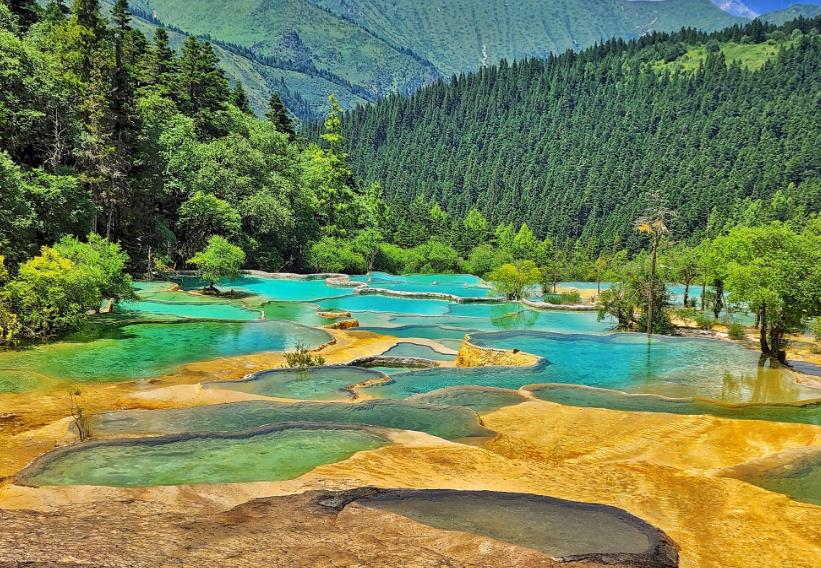
If you plan a trip to Sichuan, besides Jiuzhaigou, I highly recommend Huanglong. It features terraced colorful pools, golden travertine beaches, forests, waterfalls and snow-capped mountains. Unlike Jiuzhaigou, famous for alpine lakes and waterfalls, Huanglong’s signature is its travertine landforms stretching along the valley.
Many overseas visitors researching Huanglong search for terms like Huanglong, Huanglong Sichuan, Huanglong National Park or China Yellow Dragon. They usually want to know: Where exactly is Huanglong? Why is it called Huanglong? What attractions are worth seeing? How do I get there from Jiuzhaigou? Is one day enough for a visit?
In my opinion, Huanglong is best paired with Jiuzhaigou on the same Sichuan itinerary. Though the two scenic spots have distinct features, both sit in the Aba region of Sichuan, letting you enjoy different types of alpine natural scenery in one trip.
1. Where Is Huanglong? Geographic Location of Huanglong Scenic Area
1.1 Huanglong is located in Aba Prefecture, Sichuan Province
Huanglong sits in Songpan County, Aba Tibetan and Qiang Autonomous Prefecture, northwestern Sichuan, within the Minshan Mountain range.
It is not far from Songpan County Town, surrounded by high mountains, forests, canyons and rivers. The terrain varies greatly here, supporting a diverse alpine ecosystem and unique travertine formations.
If you search on Google Maps, enter: Huanglong Scenic Area, Songpan, Sichuan, China Or: Huanglong National Scenic Reserve
Note: Overseas travel materials often refer to it as Huanglong National Park, but its official English name is Huanglong Scenic and Historic Interest Area. It is a UNESCO World Natural Heritage Site, and its administrative classification differs from the national park system used in other countries.
1.2 Distance from Chengdu and Jiuzhaigou
For first-time visitors to Sichuan, it is essential to understand the transport links between Huanglong, Chengdu and Jiuzhaigou.
- Chengdu to Huanglong: It is a long road trip. You can also take high-speed rail to Huanglongjiuzhai Station, then transfer by car to the scenic area.
- Jiuzhaigou to Huanglong: The two sites are roughly 100 km apart. Travel time depends on the starting point, road conditions and weather.
- Songpan County Town to Huanglong: Relatively close, accessible by road.
The Huanglongjiuzhai Station opened in 2024, making travel connections between Chengdu, Huanglong and Jiuzhaigou much more convenient. However, the railway station is not right at the scenic gate, so transfer transport still needs to be arranged.
If my itinerary includes both Jiuzhaigou and Huanglong, I would prefer to take the high-speed train from Chengdu to Huanglongjiuzhai Station, then plan the sightseeing order according to train schedules and transfer options.
1.3 Why is Huanglong called China Yellow Dragon?
Huanglong literally translates to Yellow Dragon, and overseas travel resources often name it China Yellow Dragon.
The name comes from the valley’s natural landscape. Large-scale travertine deposits spread across Huanglong Valley. Golden travertine beaches and connected colorful pools extend down the valley. Viewed from above, the whole valley resembles a giant golden dragon resting among forests and snow peaks.
When sunlight hits the golden travertine, the valley shows striking colours, which inspired the evocative name “Yellow Dragon”.
2. What Makes Huanglong One of Sichuan’s Most Special Natural Landscapes?
2.1 UNESCO World Natural Heritage Site
Huanglong Scenic and Historic Interest Area was inscribed on the UNESCO World Heritage List in 1992.
Its outstanding value lies in its unique travertine landforms, alpine scenery and rich ecosystems. Unlike ordinary mountain scenic spots, Huanglong combines forests, snow-capped peaks, waterfalls and massive travertine pool groups, forming a special valley ecosystem.
When introducing Huanglong to first-time visitors, I describe it as a World Heritage site blending alpine forests, colorful pools, waterfalls and travertine formations.
2.2 Terraced travertine colorful pools
Huanglong’s iconic sights are its colorful pools. These pools vary in size and stack along the valley. Water hues shift with light, depth, mineral content and surroundings, displaying shades of blue, green, yellow and pale cyan.
They are not man-made pools; they formed slowly over time through natural mineral deposition. Standing on the viewing platform, you will be drawn to these interconnected pools, like natural terraces stretching down from the upper valley into the forest.
2.3 Alpine forests and snow-capped mountains
Huanglong offers more than colorful pools. Vast alpine forests cover the area, and tall snow peaks rise in the distance. Elevation changes dramatically here. Xuebaoding Peak, the highest point, stands at around 5,588 meters.
Different elevations support different vegetation types: mountain forests, subalpine plants and alpine meadows, creating a diverse natural habitat. On clear days, the view of pools, forests and snow peaks together is breathtaking.
2.4 Unique travertine landforms
Travertine scenery is what sets Huanglong apart from other Sichuan attractions. Simply put: water carrying calcium bicarbonate flows downhill. Changes in temperature, pressure, carbon dioxide exchange and biological activity cause calcium carbonate to deposit. Over thousands of years, this builds up travertine. The pools, travertine beaches and waterfalls in Huanglong Valley are all results of this long natural process.
Therefore, Huanglong is not only a sightseeing destination but also a valuable site for geological and ecological research.
3. Must-see Attractions in Huanglong Scenic Area
For first-time visitors to Huanglong Scenic Area, prioritize Huanglong Valley, where the most representative landscapes are concentrated.
3.1 Five-Color Ponds
The Five-Color Ponds are Huanglong’s most famous landmark and what many tourists come to see. Hundreds of pools of varying sizes gather here. Differences in water depth, mineral deposits and lighting create shifting colours. On sunny days, the water can show vivid blue, green and yellow tones. I recommend taking your time here rather than just snapping photos and rushing on.
3.2 Golden Sand Beach
Golden Sand Beach is a highly recognizable travertine landscape in Huanglong. It is a wide golden travertine flat with thin running water flowing across it. In sunlight, it glows golden. Unlike separate, enclosed pools, Golden Sand Beach is like a golden riverbed winding down the valley. It is the landscape that best illustrates the “China Yellow Dragon” name.
3.3 Welcome Ponds
The Welcome Ponds are usually the first major scenic zone after entering Huanglong Valley. They consist of many uniquely shaped pools, framed by forest, rocks and boardwalks. They are a great introduction to Huanglong’s travertine scenery for new arrivals.
3.4 Flying Waterfalls
Huanglong has not only static pools but also flowing waterfalls. Flying Waterfalls is a famous cascade in Huanglong Valley. Water tumbles down layered travertine formations, surrounded by rocks and woodland. To me, the charm of Huanglong lies in the contrast between still colorful pools and moving streams.
3.5 Washing Body Cave
Washing Body Cave is another classic travertine feature in the valley. It shows special rock structures carved by flowing water, giving visitors a chance to learn more about the area’s geological formation. If you are interested in geology, look out for the scenic area’s informational signs while walking.
3.6 Huanglong Ancient Temple
Huanglong Ancient Temple sits in the upper part of Huanglong Valley, an important cultural site within the scenic area. Huanglong is not only a natural heritage site; it is also tied to local Tibetan culture and traditional beliefs. As you hike along the valley, you can see natural scenery blending with cultural and religious relics.
4. Best Time to Visit Huanglong
Huanglong’s scenery changes dramatically with seasons. Thanks to its high elevation, temperature, rainfall and weather heavily shape your travel experience.
4.1 Summer: Great for pools and lush forests
Summer is one of the popular seasons to visit Huanglong. Vegetation is lush, and water levels are usually high, making pools, waterfalls and forests vibrant. If you want full water flow and vivid pool colours, summer is a good choice. However, summer is the rainy season in this highland region of Sichuan, so check the weather forecast before departure.
4.2 Autumn: Ideal for photography of pools and woodland
If I had to pick my favourite season, it would be autumn. Forests turn golden, orange and red, creating a sharp contrast against the blue-green pools. On clear sunny days, sunlight on travertine beaches and pools delivers rich, layered colours. Autumn is peak travel season, especially around the National Day holiday, so book transport and accommodation well in advance.
4.3 Spring: Quiet alpine scenery
Temperatures stay low in spring, and higher parts of the scenic area may still have snow. Spring is suitable for travellers who prefer quiet, uncrowded nature. Confirm opening status and weather before you go. Mountain weather changes fast in spring; pack warm windproof jackets and non-slip shoes.
4.4 Winter: Beautiful snow views, check opening status first
Snow transforms Huanglong into a winter wonderland with snow-covered peaks and forests. But note: the main Huanglong Valley may adjust opening hours or close temporarily due to winter weather and road conditions. Do not rely only on old online guides. Always check official announcements from Huanglong Scenic Area before planning a winter trip.
5. How to Get to Huanglong: From Chengdu and Jiuzhaigou
Transport is a key planning factor for a trip to Huanglong, China. For overseas visitors, I suggest sorting out the transport links between Chengdu, Huanglongjiuzhai Station, Songpan and Jiuzhaigou first, then arranging accommodation and sightseeing order.
5.1 Take high-speed rail from Chengdu to Huanglong
You can take high-speed rail from Chengdu to Huanglongjiuzhai Station. Upon arrival, transfer by shuttle bus, tourist coach or private car to the scenic area. Remember: Huanglongjiuzhai Station is not at the entrance of Huanglong, so onward transport must be arranged. Leave enough transfer time between trains and shuttles. If I take the high-speed train, I would confirm train schedules first, then arrange transfers and accommodation to avoid scrambling for transport after arriving at the station.
5.2 Travel from Jiuzhaigou to Huanglong
Many visitors combine Jiuzhaigou and Huanglong in one Sichuan trip. The two sites are roughly 100 km apart by road. You can travel by private car, tourist coach or transfer service. If travelling to Huanglong from Jiuzhaigou on the same day, confirm departure times, entry hours and return arrangements in advance. Mountain road travel time can be affected by weather, traffic and road conditions.
5.3 Travel from Songpan to Huanglong
Songpan County Town is another important transport hub for Huanglong. If you want to experience local Tibetan and Qiang culture, or visit Songpan Ancient Town before or after Huanglong, you can stay overnight in Songpan. Local tourist shuttles or private cars run from Songpan to Huanglong. This option works well if you want to combine Huanglong with surrounding attractions near Songpan.
6. How Long to Stay in Huanglong & Recommended Itineraries
Most sights are concentrated in Huanglong Valley. Since the elevation is high, the walking route includes uphill sections. I recommend first-time visitors reserve at least half a day and avoid overpacking your schedule.
6.1 Half-day itinerary
If time is limited, stick to the core sights of Huanglong Valley. Recommended route: Arrive at Huanglong scenic entrance Choose cable car or uphill walk based on your physical condition and opening status Head to Five-Color Ponds Walk downhill along the wooden boardwalk Visit Huanglong Ancient Temple, Golden Sand Beach, Washing Body Cave and Flying Waterfalls in sequence Return to the exit Follow the on-site scenic guide for the exact order and any closed trails on the day.
6.2 Full-day itinerary
If you have a full day, take your time to explore. Enter the scenic area early in the morning, first visiting the upper Five-Color Ponds and nearby viewpoints. Then walk downhill along the boardwalk to view different travertine landscapes. In the afternoon, explore extra sights according to your energy, before heading back to the exit. This suits visitors who want to fully appreciate Huanglong’s natural scenery.
6.3 3-day itinerary combining Huanglong and Jiuzhaigou
For first-time travellers to Sichuan, this combined trip is highly recommended. Sample itinerary: Day 1: Depart Chengdu for Huanglong Take high-speed rail to Huanglongjiuzhai Station, then travel to accommodation near Huanglong. Day 2: Tour Huanglong Scenic Area Spend half or a full day exploring Huanglong Valley, seeing Five-Color Ponds, Golden Sand Beach, forests and waterfalls. Travel to accommodation near Jiuzhaigou afterwards, subject to transport availability. Day 3: Tour Jiuzhaigou National Nature Reserve Visit famous sights such as Five-Flower Lake, Long Lake, Five-Color Ponds and Pearl Shoal Waterfall. If you have extra time, add one more day for deeper exploration in Jiuzhaigou or return to Chengdu.
7. Huanglong vs Jiuzhaigou: What Are the Differences & Which to Visit First?
Many visitors ask whether both are worth visiting if they are close to each other. My answer: yes, if your schedule allows. Although they are not far apart, their landscapes are completely different.
7.1 Different natural features
Jiuzhaigou is famous for alpine lakes, waterfalls, forests and snow-capped mountains. Its lakes have vivid water colours, sights are widely spread, and walking routes are well-developed. Huanglong features travertine pools, golden travertine beaches, waterfalls and alpine forests. To put it simply: Jiuzhaigou is a world of countless alpine lakes, while Huanglong is a colourful travertine corridor stretching down a valley.
7.2 Elevation and walking difficulty
The main viewing zone of Huanglong sits at a high altitude; the Five-Color Ponds area is above 3,500 meters. Jiuzhaigou is also high-altitude, but the elevation distribution of its main trails differs from Huanglong. If you are not used to high altitudes, learn about your physical limits and avoid heavy hiking right after arriving in Sichuan.
7.3 Which to visit first?
This mainly depends on transport and accommodation plans. If you take the high-speed train from Chengdu to Huanglongjiuzhai Station, visit Huanglong first then go to Jiuzhaigou. If you are already staying near Jiuzhaigou, you can visit Jiuzhaigou first and then travel to Huanglong. I suggest arranging the order based on train schedules, accommodation and weather, rather than following a fixed rule.
8. Travel Tips for Huanglong
8.1 Prepare for high altitude
The main walking area of Huanglong is high above sea level. Some visitors may suffer altitude sickness: headache, shortness of breath, dizziness or fatigue. If you live at low altitude, prepare in advance. Do not run or exercise vigorously. Walk at your own pace. Stop and seek help immediately if you feel seriously unwell.
8.2 Plan cable car and walking routes in advance
Huanglong has a cable car that reduces part of the uphill walk. Even with the cable car, you still need to walk a long way on boardwalks after reaching the upper station. If travelling with elderly people or children, consider their physical fitness before deciding whether to take the cable car.
8.3 Pack suitable clothing
Temperatures change fast at high altitude in Huanglong. It can stay cool even in summer. I recommend packing: Windproof jacket Warm layers Comfortable non-slip walking shoes Rain gear Drinking water Sun protection Pack thicker warm clothes in autumn and winter.
8.4 Protect the pools and natural environment
Huanglong’s travertine landforms are extremely precious and take thousands of years to form. Stay out of restricted zones. Do not step on travertine beaches or throw anything into the pools. Boardwalks and viewing platforms offer perfect viewing spots. Keep to marked trails to avoid damaging the fragile natural environment.
8.5 Check ticket prices and opening hours in advance
Ticket prices, cable car operating hours and opening rules change by season. Different policies apply in peak season, off-season and winter. Winter closures are common due to weather. For trips in 2026 or later, always check the latest official announcements from Huanglong Scenic Area before departure. Do not rely only on outdated guides.
9. Other Attractions Near Huanglong
If you have extra travel time, combine Huanglong with nearby cultural and natural spots.
9.1 Jiuzhaigou
Jiuzhaigou is the top destination to pair with Huanglong. It is famous for Five-Flower Lake, Long Lake, Five-Color Ponds, Nuorilang Waterfall and primeval forests. If time permits, set aside at least one full day for Jiuzhaigou instead of rushing through it in a few hours.
9.2 Songpan Ancient Town
Songpan Ancient Town is an old historic town in Sichuan’s Aba Prefecture. It was once an important transport and trade hub in northwest Sichuan, with preserved city walls, gates and traditional buildings. If you travel from Chengdu to Huanglong, you can stop briefly in Songpan to experience local history and ethnic culture.
9.3 Mounigou Valley
Mounigou Valley is part of the Huanglong Scenic Area. It has waterfalls, forests, travertine formations and alpine lakes. Zhaga Waterfall is its most famous sight. If you have toured the main Huanglong Valley and want to explore more local scenery, Mounigou Valley is a good choice.
9.4 Xuebaoding
Xuebaoding is a major peak in the Minshan Mountains, standing at roughly 5,588 meters. It is the landmark mountain of the Huanglong region. Together with surrounding snow peaks and forests, it forms Huanglong’s unique highland geography. For mountain photographers and geography lovers, learning about Xuebaoding helps you better understand the alpine landscape around Huanglong.