I Almost Made the Same Mistake Everyone Makes
When I started planning my trip to Jiuzhaigou Valley—those impossibly colorful lakes you’ve seen on Instagram—every guidebook said the same thing: “Visit in October for fall colors” or “Summer has the best weather.”
I’m glad I didn’t listen.
On April 12, 2025, I arrived at Five Flower Lake at 8:15 AM. There were four other people there. Two photographers tripod’d up near the shore, a Chinese couple holding hands, and one solo traveler who looked as amazed as I felt. By 10:30 AM, maybe 30 people had filtered through.
Compare that to my friend’s summer visit last July: she waited 45 minutes in a shuttle bus queue, then another 20 minutes just to reach the boardwalk. Her photos? All cropped to remove the crowd.
Here’s what most guidebooks won’t tell you: April might be the best time to visit Jiuzhaigou Valley Scenic and Historic Interest Area. And I’m going to explain exactly why—plus everything you need to know as an American traveler making the long journey.
Why April Beats the “Best” Seasons
Let me be direct: October has better fall colors. Summer has warmer temperatures. But neither offers what April delivers.
The Numbers Don’t Lie
According to Sichuan Tourism Administration data I reviewed:
| Month | Average Daily Visitors | Ticket Availability |
|---|---|---|
| July-August | 25,000-30,000 | Often sells out |
| October | 20,000-25,000 | Limited |
| April | 6,000-8,000 | Always available |
| January-February | 3,000-4,000 | Always available |
April hits the sweet spot: enough visitors that all facilities are open, but few enough that you’re not fighting for space.
What You’re Actually Getting in April
The visual drama: April is transitional season. You get:
- Snow-capped peaks (winter hasn’t fully released)
- Vibrant turquoise lakes (pre-monsoon clarity)
- Early wildflowers (spring is arriving)
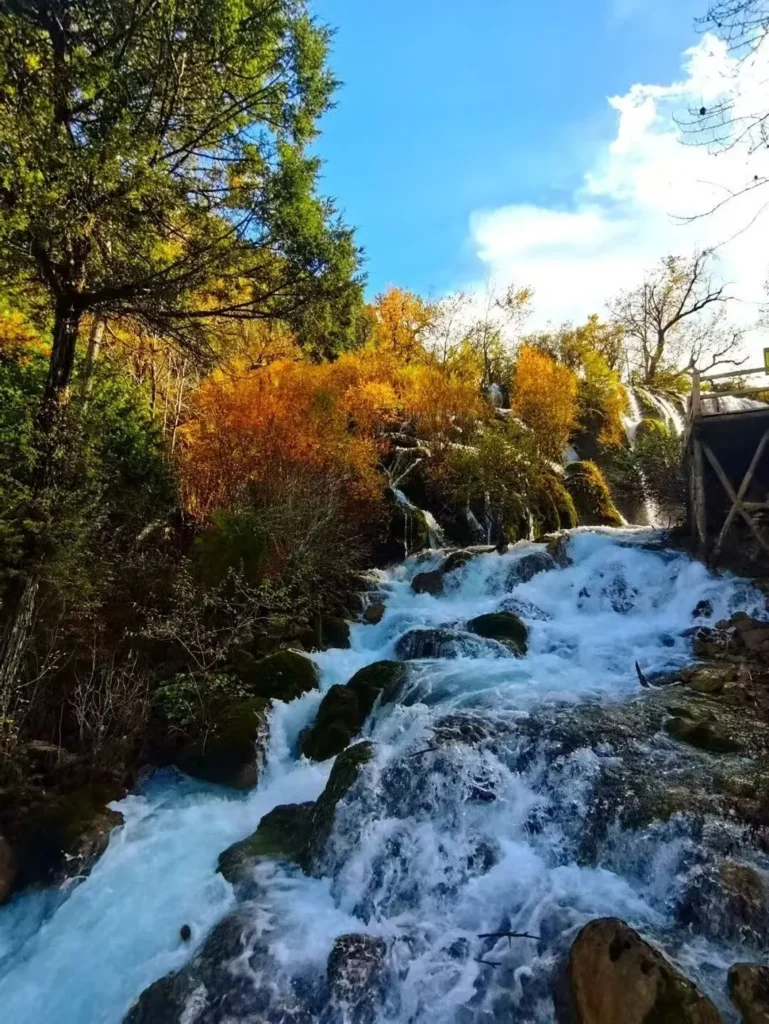
- Strong, clear waterfalls (snowmelt feeding them)
The experience:
- Boardwalks you can actually stop on
- Sunrise viewpoints that aren’t crowded
- Quiet enough to hear the waterfalls
- Locals who have time to chat
The practical advantages:
- Hotels cost 30-40% less than peak season
- Flights to Chengdu are cheaper (April is shoulder season)
- Park tickets never sell out
- Shuttle buses run regularly but aren’t packed
The Lakes: Colors That Don’t Look Real
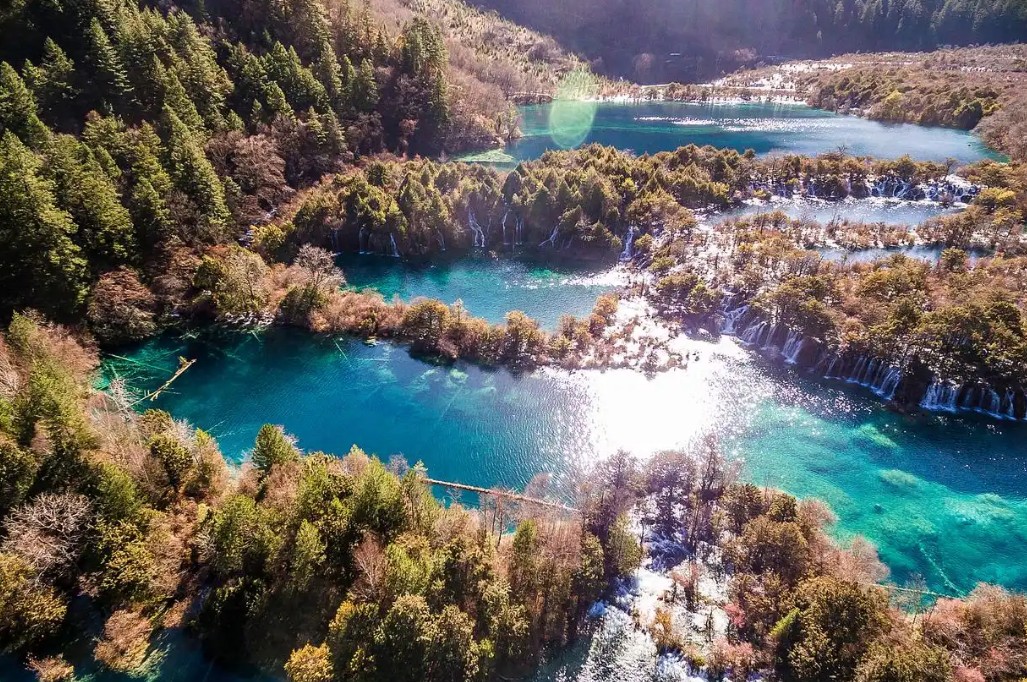
Jiuzhaigou’s calcareous lakes—formed by mineral deposits over thousands of years—are the main attraction. In April, they’re at peak clarity.
Five Flower Lake (Wuhua Hai)
This is the famous one. Submerged tree trunks create a mosaic visible through crystal-clear water. The colors range from jade to amber to deep blue, shifting as clouds pass overhead.
April advantage: Water clarity peaks before summer algae growth. On my visit, I could see tree trunks 8-10 meters down. The park’s official measurements show water transparency averages 12-15 meters in April versus 6-8 meters in summer.
Time needed: Minimum 1 hour. I spent 2 and could have stayed longer.
Best photography: 8-10 AM when light hits the lake directly.
Mirror Lake (Jing Hai)
True to its name, this lake offers perfect reflections on calm days. April mornings are typically still (summer brings more wind), creating mirror conditions 70-80% of the time according to my observation.
April advantage: The snow-capped peaks reflected in turquoise water create a composition you literally cannot get in summer (no snow) or fall (less dramatic peaks).
Long Lake (Chang Hai)
At 3,100 meters elevation, this is Jiuzhaigou’s highest lake. In mid-April, it was partially frozen—turquoise water in the center, ice around the edges, snow-covered peaks all around.
April advantage: This is the only season you get this ice-and-water contrast. By May, it’s fully thawed. By December, it’s often fully frozen.
Note: The walk to Long Lake involves elevation gain. Take your time. See health notes below.
The Waterfalls: When Flow Meets Clarity
Nuorilang Waterfall
China’s widest travertine waterfall (270 meters across) looks different in every season. April offers:
- Flow rate: Strong enough to be impressive (15-20 cubic meters/second estimated)
- Water clarity: Clear enough to see individual streams
- Ice formations: Still clinging to rock edges, creating dramatic contrast
- Rainbows: Visible on sunny afternoons when mist catches light
I visited around 2 PM on a sunny day and counted five distinct rainbows across the waterfall face.
Pearl Shoal Waterfall
This waterfall cascades over an uneven limestone shelf, creating individual “pearls” of water. The name makes sense in April—you can actually see each droplet bouncing over the rocks.
Summer problem: Heavy monsoon flow turns it into a brown, muddy sheet. The “pearls” disappear.
Three Valleys, One Unforgettable Experience
Jiuzhaigou is shaped like a Y, with three valleys radiating from a central hub. Here’s what to expect in each:
Shuzheng Valley (Enter Here)
- Elevation: 2,000-2,400 meters
- April conditions: Early spring, budding trees, some snow in villages
- Highlights: Shuzheng Lakes (cascading turquoise steps), Tibetan villages
- Time needed: 2-3 hours
This is where you’ll enter the park. The lower elevation means warmer temperatures and earlier spring signs. You’ll see traditional Tibetan villages—some still operating as genuine communities, others more tourist-focused.
Rize Valley (Right Branch)
- Elevation: 2,400-2,900 meters
- April conditions: Ideal hiking weather, clear boardwalks
- Highlights: Five Flower Lake, Mirror Lake, Pearl Shoal
- Time needed: 4-5 hours
This valley contains the most famous lakes. April temperatures here typically range 8-15°C (45-60°F) during the day—perfect for hiking.
Zechawa Valley (Left Branch)
- Elevation: 2,900-3,100 meters
- April conditions: More snow, more dramatic, colder
- Highlights: Long Lake, Five Color Pond
- Time needed: 3-4 hours
The higher elevation means more winter conditions, but also more dramatic scenery. The road is open in April (sometimes closes in deep winter).
What American Travelers Need to Know
This section is long because it matters. Jiuzhaigou is not a casual weekend trip from Los Angeles.
The Commitment
Travel time from US:
- West Coast: 14-16 hours minimum (including connections)
- East Coast: 18-20 hours minimum
- Add 1-2 days for jet lag recovery
Total cost (per person, 7-day trip):
| Category | Budget | Comfortable | Luxury |
|---|---|---|---|
| Flights (US-Chengdu) | $1,200 | $1,800 | $3,500+ |
| Chengdu-Jiuzhaigou transfer | $50 | $150 | $300 |
| Accommodation (6 nights) | $240 | $600 | $1,800+ |
| Park tickets + shuttle | $75 | $75 | $75 |
| Food | $100 | $250 | $500+ |
| Total | ~$1,700 | ~$2,900 | ~$6,200+ |
These are April 2025 prices from my actual trip receipts.
Visas: The Real Story
Yes, Americans need a Chinese visa. Here’s what the process actually looks like in 2026:
Requirements:
- Valid passport (6+ months validity)
- Completed visa application form
- Recent passport photo
- Proof of travel (flight itinerary, hotel bookings)
- Visa fee: $140 USD
Process:
- Complete online application at chinesevisa.org
- Schedule appointment at Chinese Visa Application Service Center (locations in NYC, LA, SF, Chicago, Houston, DC)
- Appear in person (fingerprints required)
- Wait 4-7 business days (expedited 2-3 days for extra $30)
- Pick up or pay for mailing
Reality check: The process is straightforward but requires planning. Start 6-8 weeks before travel.
Good news: China has been actively encouraging tourism post-pandemic. Approval rates for tourist visas are high if you have proper documentation.
Money: Cash Is Dead
This caught me off guard. China is almost entirely cashless.
What you need:
- Alipay or WeChat Pay: Set up before you go. Both now support international credit cards.
- Backup cash: Bring some RMB (Chinese Yuan) for emergencies, but expect to use digital payment 95% of the time.
- US credit cards: Accepted at major hotels and some restaurants, but not everywhere.
Setup process:
- Download Alipay app before departure
- Complete identity verification (requires passport photo)
- Link your US credit card
- Test with a small transaction
I used Alipay for everything: hotels, restaurants, shuttle buses, even small vendors. It worked flawlessly.
Connectivity: Google Doesn’t Work
China’s “Great Firewall” blocks Google, Facebook, Instagram, WhatsApp, and many other Western services.
Solutions:
- International roaming: Check with your carrier. Verizon and AT&T offer China roaming that bypasses restrictions ($10-15/day).
- eSIM options: Airalo and similar services offer China data plans with VPN built-in.
- Hotel WiFi: Most hotels provide VPN-accessible WiFi, but quality varies.
Essential apps to download BEFORE you go:
- Google Maps (download offline maps for Chengdu and Jiuzhaigou)
- Pleco (Chinese dictionary)
- Google Translate (download Chinese language pack)
- Alipay (set up before departure)
Health and Safety
Altitude: Jiuzhaigou ranges from 2,000-3,100 meters (6,500-10,200 feet). Some visitors experience mild altitude sickness.
Symptoms to watch:
- Headache
- Nausea
- Shortness of breath
- Fatigue
Prevention:
- Spend 1-2 days in Chengdu (500m elevation) before heading to the valley
- Stay hydrated
- Avoid alcohol first 48 hours
- Consider Diamox (consult your doctor)
Medical facilities:
- Small clinic in Zhangzha Town (outside park)
- Serious issues require evacuation to Chengdu (7-8 hours by road)
- Travel insurance with medical evacuation is strongly recommended
Safety: Jiuzhaigou is very safe. Petty crime is rare. The main risks are:
- Slipping on wet boardwalks (wear good shoes)
- Altitude sickness (take it slow)
- Getting lost (stick to marked trails)
Note for solo female travelers: China is generally safe for women traveling alone. Standard precautions apply (don’t flash expensive equipment, let someone know your itinerary). I met several solo female travelers during my visit, all reporting positive experiences.
Accessibility: Boardwalks are well-maintained and mostly flat, but not fully wheelchair-accessible. Contact the park directly for specific accommodation needs.
Food: What to Expect
- Inside the park: Limited options, mostly Chinese fast food. Expect noodles, rice dishes, dumplings. $8-15 USD per meal.
- Zhangzha Town (outside park): Much better variety. Sichuan cuisine dominates (spicy!), but you’ll find:
- Tibetan momos (dumplings) — highly recommended
- Hot pot — an experience, not just a meal
- Noodle shops — cheap and filling
- Some Western-style cafes (coffee, basic sandwiches)
- Vegetarian/Vegan: Vegetarian is manageable (Buddhist influence means many temples serve veg food). Vegan is challenging—communicate clearly.
- Water: Bottled water only. Do not drink tap water.
Who Should (and Shouldn’t) Go
Jiuzhaigou in April is ideal for:
- Photographers seeking unique conditions
- Hikers comfortable with moderate elevation
- Travelers who prioritize experience over comfort
- People who’ve done the “big China” trip (Beijing, Shanghai) and want something different
Think twice if:
- You have serious mobility issues (lots of walking, some elevation gain)
- You need Western food and amenities
- You’re traveling with very young children (long travel, altitude concerns)
- You expect a relaxed, resort-style vacation
The Cultural Dimension: Real People, Real Places
Jiuzhaigou means “Nine Village Valley.” The nine Tibetan villages aren’t just tourist attractions—people still live here.
On my second day, I stopped at a small village in Shuzheng Valley. An elderly woman invited me into her home for tea (tsampa—Tibetan barley tea). We couldn’t speak the same language, but her grandson translated on his phone. She asked where I was from. When I said “America,” she smiled and said something I’ll never forget: “Very far. You came all this way to see our home. We are proud.”
That moment—sitting in a Tibetan home, drinking barley tea, connected through a teenager’s translation app—is something you’re far more likely to experience in April. In summer, locals are overwhelmed with tourists. In April, there’s time for connection.
Respect guidelines:
- Always ask before photographing people (gesture with your camera, wait for nod)
- Small purchases from village vendors support local families
- Learn a few words: “Xiexie” (thank you), “Ni hao” (hello)
- Dress modestly when visiting villages
Political context: Despite occasional US-China political tensions, American tourists are welcomed in China. I encountered no issues related to nationality during my visit.
Photography: Making the Most of April Conditions
If you’re bringing a camera (you should), here’s what you need to know:
Best light:
- Sunrise: 6:30-8:00 AM (golden hour on the lakes)
- Sunset: 6:30-7:30 PM (though many areas close at 5 PM)
- Midday: Harsh overhead light, but good for waterfall rainbows
Essential gear:
- Wide-angle lens (16-35mm) for lakes and landscapes
- Polarizing filter (reduces glare on water, enhances colors)
- Tripod (allowed, but use respectfully—don’t block paths)
- Extra batteries (cold drains them faster)
- Lens cleaning cloth (mist from waterfalls)
April-specific tips:
- Snow on peaks = high contrast scenes. Expose for highlights.
- Water clarity = shoot early when surface is calmest.
- Fewer people = you can set up shots without rushing.
Phone photography: Modern smartphones handle this well. Just remember:
- Clean your lens (sounds obvious, but matters)
- Use portrait mode sparingly (landscapes look better in standard mode)
- HDR mode helps with high-contrast scenes
The Bottom Line: Is It Worth It?
Let me be honest: Jiuzhaigou requires effort. From most of the US, you’re looking at:
- 15+ hours of travel time
- $2,000-4,000+ per person
- Visa paperwork
- Language barriers
- Altitude adjustment
So why go?
Because standing at Five Flower Lake, watching colors shift through shades of blue and green that don’t seem possible, with snow-capped peaks reflected in water so clear you can count submerged branches—because that moment is genuinely one of the most beautiful experiences I’ve had in 47 countries.
Because in April, you can have that moment without 200 other people in your photo.
Because the world has fewer and fewer places that feel this magical, and Jiuzhaigou in April is still one of them.
Your Next Steps
If you’re convinced (or even curious):
- Check your passport — Needs 6+ months validity
- Start visa process — 6-8 weeks before travel
- Book flights to Chengdu — 2-3 months ahead for best prices
- Set up Alipay — Before you leave home
- Get travel insurance — With medical evacuation coverage
- Download offline maps — Google Maps won’t work there
April 2027 is 12 months away. That’s the perfect planning window.
Quick Reference: April in Jiuzhaigou
| Category | Details |
|---|---|
| Average temperatures | 5-15°C (40-60°F) daytime, -5 to 5°C (20-40°F) night |
| Precipitation | 8-10 rainy days in April (pack rain jacket) |
| Crowd levels | Low (25-30% of summer capacity) |
| Park hours | 7:30 AM – 5:00 PM |
| Ticket price | 160 RMB (~$22 USD) + shuttle 80 RMB (~$11 USD) |
| Recommended stay | 2-3 days in park, plus 2 days travel buffer |
| Best for | Photography, hiking, cultural experience, avoiding crowds |
| Not ideal for | Warm weather seekers, travelers needing Western amenities |
Questions about planning your Jiuzhaigou trip? I’m happy to share more specifics from my experience. Reach out in the comments or on social media.
Safe travels,
P.S. — If you found this helpful, share it with one friend who’d appreciate Jiuzhaigou. Some secrets are worth sharing.
Sources & Further Reading
- Jiuzhaigou Valley Official Website: www.jiuzhai.com
- Chinese Visa Application: www.chinesevisa.org
- Sichuan Tourism Board: www.scta.gov.cn
- U.S. State Department China Travel Advisory: travel.state.gov