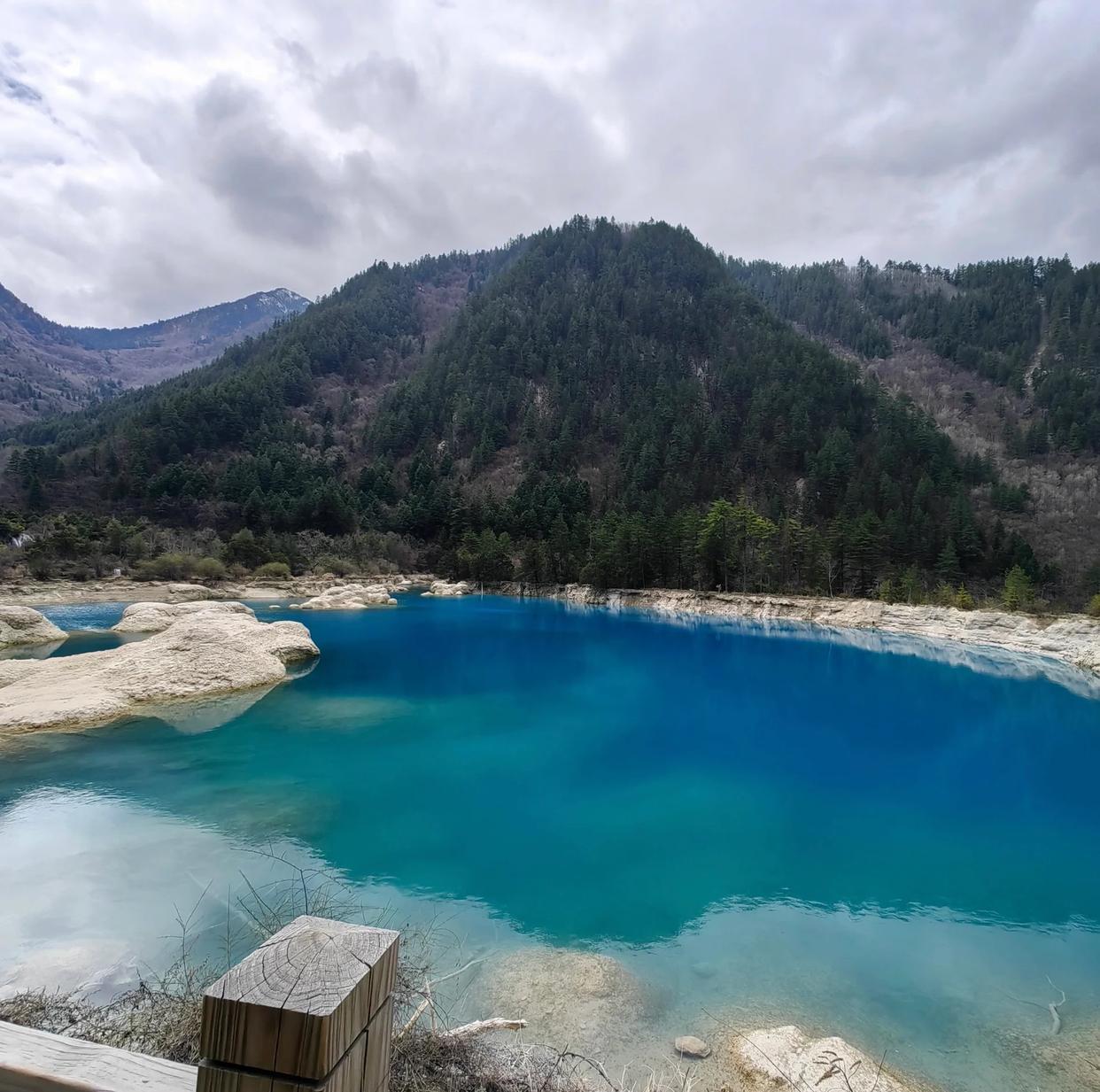
The water wasn’t blue. It was turquoise. Teal. Cobalt. All three at once, shifting every few seconds as clouds passed overhead — a lake that couldn’t decide what color it wanted to be, so it chose all of them. I tightened my jacket against the October chill at 3,000 meters and realized something: I’d flown 24 hours from New York for one valley in China, and I had no idea what I was standing next to.
A German backpacker lowered his camera next to me at Five Flower Lake and said, “I thought the pictures were fake.”

“Same,” I said. “But I’m starting to think the pictures don’t get close.”
That’s Jiuzhaigou. And if you’re reading this, you’ve probably seen those photos — the lakes that look like liquid gemstones, the waterfalls that tumble through autumn forests, the Tibetan prayer flags against snow-dusted peaks. You’ve maybe even done the first thing every American does when they see those photos: open Google and type, “What city is Jiuzhaigou in?”
Here’s the honest answer — and the reason I’m writing this.
What City Is Jiuzhaigou In? (The Answer Nobody Gives Straight)
Technically: Zhangzha Town, Jiuzhaigou County, Aba Tibetan and Qiang Autonomous Prefecture, Sichuan Province, China.
That’s useless to you. Here’s the real answer:
Jiuzhaigou is not in a city. It’s not like saying “Yellowstone is in Wyoming” or “Yosemite is in California.” Those places are national parks with gateway towns nearby. Jiuzhaigou is in one of the most remote, high-altitude, culturally distinct corners of China — a region where the nearest “city worth naming” is 成都, 250 miles and a world away. Think of it this way: if you dropped Jiuzhaigou into the American West, it would sit somewhere between the Grand Canyon’s remoteness and Denali’s altitude — except surrounded by Tibetan villages instead of ranger stations.
You get there by flying into 成都, Sichuan’s capital (direct flights from LA, San Francisco, and New York now exist). From Chengdu, you take a one-hour domestic flight to Jiuzhai Huanglong Airport, or increasingly, the new high-speed train that’s quietly transforming access to this entire region. The drive — winding mountain roads through river gorges — is an experience itself.
The name “Jiuzhaigou” means “Valley of Nine Villages,” named for the Tibetan communities that have lived here for over a thousand years. That matters. Because you’re not just visiting a pretty park. You’re entering a place where people still live the way they have for centuries — and where, it turns out, Jiuzhaigou is only the opening act.
What’s Inside the Valley Itself
Before we leave Jiuzhaigou for its neighbors, let’s talk about why you’re flying across the planet in the first place.
The valley runs about 30 kilometers end to end, shaped like a Y. You board a shuttle bus that drops you at the top branches, then work your way down on foot or hop between stops. At the crown sits 長湖 (Changhai), 3,060 meters up — the highest and largest lake in the park, deep cobalt blue, flanked by snow-capped peaks that linger well into spring. It’s the kind of view that makes you stop mid-sentence.
Down from Long Lake, 五花湖 does its color-shifting trick — the shallow, mineral-rich water throws emerald, turquoise, and amber depending on where the sun hits. 珍珠灘瀑布 isn’t a single cascade so much as a 160-meter-wide sheet of water tumbling over a limestone shelf in a thousand tiny rivulets, each one catching light like scattered pearls. Then there’s 諾日朗瀑布 — 310 meters wide, the widest waterfall in China, and if you’ve seen a photo of Jiuzhaigou on a travel brochure, there’s a good chance this was it.
The lower valley strings together a series of lakes and falls — Shuzheng Lakes, Sparkling Lake, Reed Lake — each with its own personality, each connected by wooden boardwalks that thread through forests turning gold and crimson in autumn.
A full day gets you through the highlights. Two days lets you slow down, skip the crowds, and find corners where the only sound is water moving over stone. Either way, you’ll leave with the same thought I had: this place is not overhyped.
But here’s where it gets interesting. The valley I just described — the one with 108 alpine lakes, the widest waterfall in China, the autumn forests that look like a CGI render — is not the whole story. It’s barely the beginning.
The Big Revelation: Jiuzhaigou Is Not Alone
Here’s what I wish someone had told me before I booked my trip.
Jiuzhaigou sits in Aba Prefecture, an area smaller than Colorado that somehow packs in more world-class natural wonders than most entire countries. We’re talking UNESCO World Heritage sites, glaciers you walk on, sacred mountains that rival the Alps, and grasslands that make Montana look modest.
Aba is what you’d get if you took Yellowstone’s geothermal weirdness, Banff’s impossibly blue lakes, the Rockies’ altitude, and the Serengeti’s open grasslands — then compressed it all into a single road-trip loop.
I flew to China expecting to see one valley. I left realizing that Jiuzhaigou was just the door.
So here’s what’s next door — ranked by how much they surprised me.
1. Huanglong: The Only Place That Made Jiuzhaigou Seem Normal
If you add exactly ONE extra stop to your Jiuzhaigou trip, make it this one.
Huanglong (Yellow Dragon) Valley is about 100 kilometers from Jiuzhaigou — two hours by car. On paper, it’s “another valley with colorful pools.” In reality, it’s one of the most absurd natural formations I’ve ever seen: a 3.6-kilometer cascade of over 3,400 travertine pools, stacked like rice terraces made of gold, turquoise, and emerald.
Imagine walking up a wooden boardwalk and for two straight miles, every direction you look, there’s another pool of mineral-rich water shifting through colors that shouldn’t exist in nature. At the top sits Five-Color Pond — a single pool so saturated with minerals it looks like someone spilled a painter’s entire palette and the mountain just… kept it.
Huanglong is also a UNESCO World Heritage site. The altitude is brutal — you start around 3,000 meters and climb to nearly 3,900 (12,800 feet, higher than any point in the lower 48). I watched a fit-looking Australian couple turn back halfway, faces pale. Do not underestimate altitude here. Give yourself a day in the region before attempting this hike. Your lungs will thank you.
2. Siguniang Mountain: China’s Alps (No, Really)
Mountains in China can be underwhelming — crowded, paved, commercialized. Siguniang (Four Sisters) Mountain is the opposite.
Two hundred kilometers south of Jiuzhaigou, four connected peaks punch through the sky at 6,250 meters — 20,505 feet. That’s nearly Denali’s height, and taller than any peak in the contiguous United States by a mile. Chinese climbers call them “the Alps of the East,” which for once isn’t travel-brochure hyperbole.
The area has three valleys. Shuangqiao is the accessible one — shuttle buses, wooden walkways, alpine meadows with grazing yaks. Changping is for hikers and horseback riders who want to go deeper. Haizi is untamed backcountry for serious trekkers only.
What makes Siguniang different from, say, a Colorado fourteen-er is the culture layered on top: Tibetan prayer flags strung across mountain passes, mani stones stacked at every trailhead, monasteries tucked into valleys where monks still chant at dawn. You’re not just looking at mountains. You’re walking through someone’s sacred geography.
3. Dagu Glacier: Summer Sweating, Then Walking on Million-Year-Old Ice
Here’s a sentence I never thought I’d write: you can ride the world’s highest cable car to a 4,860-meter glacier platform in western China, step out, and touch ice that predates human civilization. That altitude — 15,944 feet — means the air carries barely half the oxygen you’re used to. Every step on the viewing platform feels earned. Even holding your camera up for a photo takes conscious effort.
Dagu Glacier, in Heishui County, is about three hours from Jiuzhaigou. In July, you can be sweating in a t-shirt at the base and an hour later zipping up every layer you own, standing on a massive ice field that hasn’t disappeared for millions of years. The contrast is disorienting in the best way.
There’s history here too. This was the last snow mountain the Red Army crossed during the Long March. The visitor center tells that story well — geological time and human endurance side by side.
4. Ruoergai Grassland: Where China Goes Flat and Infinite
Three hours north of Jiuzhaigou, the mountains simply… stop. In their place: the Ruoergai Grassland, one of China’s three largest wetlands, stretching to every horizon like Kansas but with yaks instead of wheat.
In summer, wildflowers turn the entire thing into a purple-yellow-white carpet. Tibetan nomads still graze herds here — you can book a homestay in a black yak-hair tent, drink yak butter tea by a dung fire, and wake up to a sunrise that makes the whole grassland glow. There’s no cell service. There’s no souvenir shop. There’s just you, a sky that feels too big, and a silence you didn’t know you needed.
Nearby, the First Bend of the Yellow River delivers one of the best sunsets I’ve ever seen. China’s “Mother River” cuts a massive S-curve through the plateau, and when the light hits it right, the water turns molten orange. That’s the moment when the 24-hour flight stops feeling like a cost and starts feeling like a bargain.
But here’s the thing: the mountains and lakes fade into memory faster than you expect. What I still think about, months later, are the people I met between them.
What All of This Actually Feels Like
Western travel media treats Chinese destinations like checkboxes: see the pandas, walk the Wall, snap the Terracotta Warriors, done. Aba Prefecture doesn’t fit that script.
The Tibetan villages around Jiuzhaigou aren’t museum exhibits. People live here. Prayer wheels spin in mountain streams powered by nothing but gravity. Elderly women in traditional dress pass you on trails with a nod — they might not speak Mandarin, let alone English, but they’ll offer you tea if you’re cold. The Qiang people — one of China’s oldest ethnic minorities, older than the Han majority — build stone watchtowers that have survived centuries of earthquakes.
The food tells the same story. Yak hotpot in winter is nothing like the numbing Sichuan hotpot Americans know from Chinatown. It’s rich, warming, built for people who live above the treeline. Highland barley wine is slightly sour, slightly sweet, and your host will keep refilling your cup whether you want it or not. Barley and potatoes grown at 3,000 meters taste sweeter than anything from sea level.
Is It Safe? Can I Actually Do This?
I know what you’re thinking. You’ve never been to China, or maybe you’ve only done Beijing/Shanghai. Western Sichuan — Aba Prefecture — sounds remote and intimidating. So let’s be direct.
Safety: Aba is a tourist region. The Tibetan and Qiang communities are famously hospitable. Violent crime against tourists is virtually nonexistent. The biggest danger you’ll face is underestimating the altitude — not people.
Getting around: The high-speed train and highway system connecting Chengdu to the Aba region have improved dramatically in recent years. You can book private drivers through hotels or travel agencies at very reasonable rates. Many younger drivers speak basic English. If you’re a confident driver, rental cars are an option — but I wouldn’t recommend it on mountain roads unless you’ve driven in places like the Rockies or the Alps before.
語言: Signs in Jiuzhaigou and Huanglong are bilingual (Chinese/English). In smaller towns and homestays, English disappears fast. Download Pleco or an offline Chinese translation app. Learn five phrases — “hello,” “thank you,” “how much,” “where is the bathroom,” and “this is delicious.” That’s enough. Tibetans and Qiang locals are patient with foreigners in a way that surprised me. A smile goes further than grammar.
高山症: Jiuzhaigou has medical stations. Huanglong’s trail has oxygen canisters for sale at rest points. If you feel dizzy, nauseous, or have a pounding headache, descend immediately — don’t push through. Symptoms usually resolve within hours of getting to lower elevation. The nearest proper hospital is in Songpan or Jiuzhaigou County seat. For peace of mind, travel insurance that covers high-altitude medical evacuation is a few dollars a day. Worth it.
Food and water: Stick to bottled water. The restaurants in tourist zones serve clean, excellent food — I never got sick. If you’re staying in a Tibetan homestay, embrace the yak butter tea. It’s an acquired taste, but it’s also the best altitude-sickness remedy the locals know.
The bottom line: if you’ve camped in a US national park, you’re more than prepared for Aba. The infrastructure is better than you expect, and the people are warmer than any guidebook will tell you.
If You’re Flying From the US: A Realistic Plan
When to go: Late October hit the sweet spot for me — peak autumn colors but thinning crowds. September through October is the classic window. April through June gets you wildflowers and fewer tourists. Winter (December through February) delivers frozen waterfalls, snow-dusted temples, and near-empty trails — cold as hell, but magical if you dress right.
Altitude reality check: Jiuzhaigou sits at 2,000-3,100m. Huanglong goes to 3,900m. Dagu Glacier tops 4,860m. Altitude sickness doesn’t care about your fitness level. Drink water obsessively. Walk slower than you think you need to. Take a full rest day on arrival — the park isn’t going anywhere.
If you have 3 extra days: Do Jiuzhaigou (two full days) + Huanglong (one day). This is the minimum “I didn’t waste my flight” itinerary.
If you have 5-7 extra days: Add Siguniang Mountain (two days) and the Ruoergai Grassland / First Bend of the Yellow River (two days). This turns a trip into a journey.
If you’re going all in: Loop through Dagu Glacier, spend a night in a Tibetan homestay on the grasslands, and come back through Chengdu for hotpot and pandas. That’s 10-12 days and you’ll still feel like you missed something. You did. That’s the point — this region rewards return visits.
Visas: Americans need a tourist (L) visa, applied for at a Chinese embassy or consulate before travel. Book park tickets online in advance — Jiuzhaigou caps daily visitors.
One Lake, Six Discoveries, Zero Regrets
I went to China to see one valley. I came back with a list of places I still haven’t seen, a newfound respect for what “remote” really means, and a photo of Five Flower Lake that still looks fake even though I took it myself.
Jiuzhaigou is worth every mile. But it’s not a destination. It’s a starting point. The real answer to “what city is Jiuzhaigou in” isn’t a city — it’s an invitation. You’re about to discover an entire corner of the planet that most American travelers don’t even know exists.
Next time, I’m going deeper into the grasslands — chasing the Milky Way above a Tibetan nomad camp, no itinerary, no deadline, just a sky that goes on forever. This region isn’t something you finish. It’s something you come back to.
Pack layers, drink water, and go.