Introduction: Why This Route Steals Hearts
I’ll be honest—I was terrified about my first trip to China. The language barrier, the sheer size of the country, the unfamiliar customs. It felt overwhelming. But then a friend whispered three words that changed everything: “Chengdu/Leshan/Emeishan.”
Three cities. One perfect triangle. Two weeks that transformed how I think about travel.
This is the route I wish someone had handed me before I landed at Chengdu Shuangliu Airport, jet-lagged and clutching my phrasebook like a lifeline. It’s the perfect introduction to China for American travelers who want authenticity without the chaos, culture without the confusion, and adventure without the anxiety.
Let’s dive in.
Why This Route? The Magic of the Sichuan Triangle
Here’s what makes Chengdu/Leshan/Emeishan special: you get three completely different experiences within a few hours of each other.
Chengdu is your soft landing—a modern, livable city where ancient tea houses sit alongside trendy coffee shops, where you can watch pandas in the morning and hunt for the perfect mapo tofu by night. It’s China’s most relaxed major city, and locals will tell you it’s because everyone knows life is too short to rush.
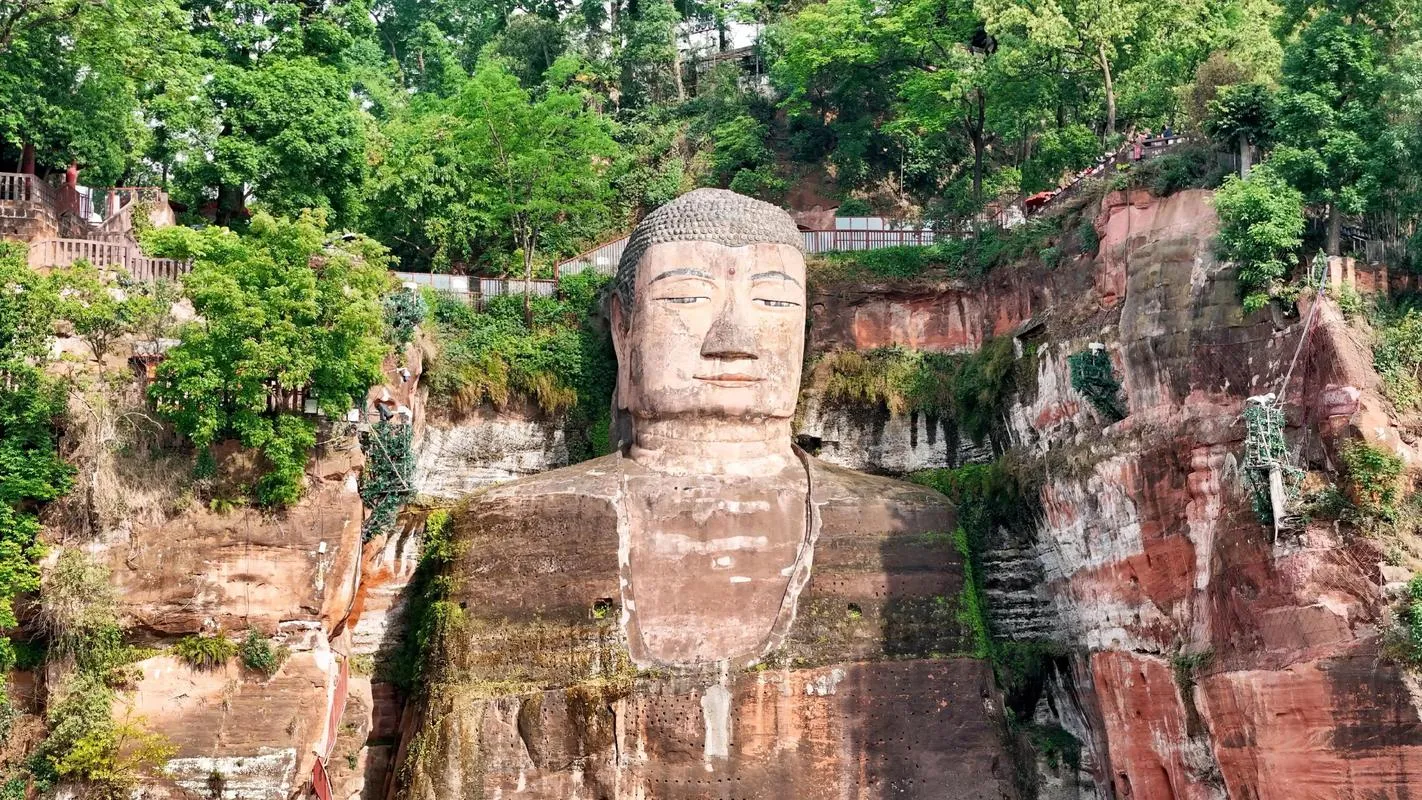
Leshan is your history fix. Home to the world’s largest stone Buddha, carved into a cliff face during the Tang Dynasty over 1,200 years ago. Standing at those feet, craning your neck up at a 71-meter-tall statue that’s seen empires rise and fall, you feel something shift inside you. It’s humbling in the best way.
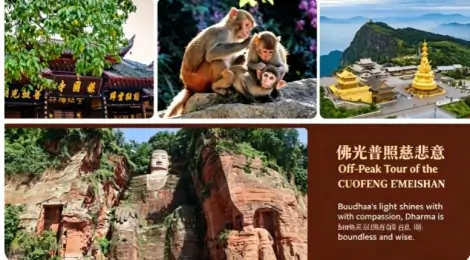
Emeishan is your spiritual reset. One of China’s Four Sacred Buddhist Mountains, with temples clinging to misty peaks, forests so old they feel primordial, and a sunrise from the Golden Summit that will make you forget to breathe. Oh, and mischievous monkeys who’ve perfected the art of stealing snacks from tourists.
The beauty? You can do all three in 5-7 days without feeling rushed. The high-speed rail connects them like beads on a string. And unlike Beijing or Shanghai, you won’t spend half your trip in lines or battling crowds.
Quick Decision Framework: Is This Route Right for You?
Choose Chengdu/Leshan/Emeishan if you:
✅ Want your first China trip to feel manageable, not overwhelming
✅ Love pandas, Buddhist culture, or mountain scenery
✅ Prefer food-focused travel with authentic local experiences
✅ Have 5-7 days available for a regional trip
✅ Want modern infrastructure without sacrificing cultural depth
Consider Beijing/Shanghai/Xi’an instead if you:
❌ Your dream is seeing the Great Wall or Terracotta Warriors
❌ You’re fascinated by imperial Chinese history (Ming/Qing dynasties)
❌ You want ultra-modern skyscrapers and cosmopolitan vibes
❌ You have 10+ days for a comprehensive China tour
Bottom line: This route is perfect for first-timers who want a gentle introduction to China without skipping the wow moments.
Your Itinerary at a Glance
5-Day Express Route
| Day | Location | Highlights | Overnight |
|---|---|---|---|
| 1 | Chengdu | Arrive, settle in, evening hot pot | Chengdu |
| 2 | Chengdu | Panda base (morning), Wide & Narrow Alleys, Sichuan opera | Chengdu |
| 3 | Leshan | High-speed train, Giant Buddha, return to Chengdu | Chengdu |
| 4 | Emeishan | Train to Emei, Baoguo Temple area, hot springs | Emeishan |
| 5 | Emeishan → Chengdu | Golden Summit sunrise, descend, depart | — |
7-Day Relaxed Route
| Day | Location | Highlights | Overnight |
|---|---|---|---|
| 1 | Chengdu | Arrive, rest, casual exploration | Chengdu |
| 2 | Chengdu | Panda base (3-4 hours), afternoon tea house | Chengdu |
| 3 | Chengdu | Jinli Ancient Street, Wenshu Monastery, food tour | Chengdu |
| 4 | Leshan | Day trip to Giant Buddha, old town dinner | Chengdu |
| 5 | Emeishan | Train to Emei, Baoguo Temple, hot springs | Emeishan |
| 6 | Emeishan | Golden Summit sunrise, temple hiking | Emeishan |
| 7 | Emeishan → Chengdu | Descend mountain, return to Chengdu, depart | — |
Pro tip: The 7-day route gives you buffer time for jet lag, spontaneous discoveries, and that extra bowl of noodles you’ll inevitably want.
Before You Go: Essential Practical Tips
Visas & Entry Requirements (2026 Update)
Standard Tourist Visa:
American citizens need a visa for China. Apply at the Chinese Visa Application Service Center (www.visaforchina.org). Tourist (L) visas typically cost $140-200 depending on processing speed. Processing time: 4-7 business days for standard, 2-3 days for expedited (extra $50-100).
144-Hour Visa-Free Transit:
China offers 144-hour (6-day) visa-free transit for Americans connecting through to a third country. Example: USA → Chengdu → Thailand qualifies. You must have confirmed onward tickets and stay within Sichuan province. This is perfect for the 5-day itinerary above.
Important: Policies can change. Verify current requirements at travel.state.gov or contact the Chinese consulate 2-3 months before departure.
Internet & VPN
Google, Facebook, Instagram, WhatsApp, and most Western apps are blocked in China.
Before you arrive:
– Install 2-3 VPNs on your phone and laptop (ExpressVPN, NordVPN, and Astrill have been reliable, but check recent Reddit r/ChinaTravel threads for current status)
– Download offline maps (Maps.me or Google Maps offline areas)
– Install Pleco (Chinese dictionary) and Google Translate with offline Chinese pack
Alternative: China Unicom’s “King Card” SIM (19 yuan/$3 per month + data packages) comes with built-in access to many blocked sites, though not all. Pick up at Chengdu airport upon arrival.
Money & Payment
China is almost cashless. Alipay and WeChat Pay are everywhere.
Setup before arrival:
– Download Alipay and link your international credit card (Visa/Mastercard work; Chase Sapphire, Capital One have no foreign transaction fees)
– Test a small transaction before you leave home
Cash backup:
Carry 500-1000 yuan ($75-150) for small vendors, temple donations, and rural areas. ATMs from ICBC and Bank of China accept international cards (expect 3-5% foreign transaction fees).
Safety: What American Travelers Need to Know
Good news: Chengdu, Leshan, and Emeishan are very safe for tourists.
Violent crime: Extremely rare against tourists. I walked alone at night in Chengdu without concern.
Petty crime: Pickpocketing exists in crowded areas (Chunxi Road, train stations) but is less common than in major European cities. Use a money belt or crossbody bag, keep valuables secure.
Scams to watch for:
– Tea house scam: Someone invites you to a “traditional tea ceremony,” then you’re presented with a $200 bill. Politely decline unsolicited invitations.
– Fake monks: At tourist sites, “monks” may ask for donations. Real monks don’t solicit money.
– Taxi meter tricks: Insist the driver uses the meter, or use Didi (China’s Uber) for transparent pricing.
Emergency numbers:
– Police: 110
– Ambulance: 120
– Fire: 119
– English-speaking hotline: 12308 (China National Tourism Administration)
Solo female travelers: I traveled alone for half this trip and felt safe everywhere. Standard precautions apply: don’t flash expensive jewelry, trust your gut, and let someone know your itinerary.
Accessibility Notes
Chengdu:
– Panda base has paved paths and is wheelchair-accessible
– Metro stations have elevators (look for accessibility symbols)
– Most restaurants are ground-level or have ramps
Leshan:
– Boat view is fully wheelchair-accessible — best option for mobility-limited visitors
– Cliff staircase is NOT accessible (steep, narrow steps)
– Old town has some cobblestone streets
Emeishan:
– Cable car + bus option eliminates need for hiking
– Golden Summit viewing platform is accessible
– Temple paths can be uneven; bring sturdy shoes
General: Download the accessibility map feature in Alipay—many venues now list wheelchair access info.
Dietary Restrictions
Vegetarians/Vegans:
Sichuan cuisine is meat-heavy, but options exist:
– Mapo tofu (ask for no meat: 不要肉 – bù yào ròu)
– Stir-fried seasonal vegetables (炒时蔬 – chǎo shí shū)
– Buddhist temple restaurants serve excellent vegetarian food
– In Chengdu: Try “Vegetarian House” near Wenshu Monastery
Gluten-free:
– Rice noodles (米粉 – mǐ fěn) are safe
– Many dishes use soy sauce (contains wheat)—ask for gluten-free soy sauce or none
– Hot pot: Request clear broth without soy-based seasonings
Nut allergies:
Sichuan food uses peanuts and cashews frequently. Learn: 我对坚果过敏 (wǒ duì jiān guǒ guò mǐn = I have a nut allergy). Carry translation cards.
Spice tolerance:
Sichuan food is SPICY. “Wei la” (微辣) = mild spicy. “Bu yao la” (不要辣) = no spicy. Even “mild” may be hot for American palates.
Language Essentials
Download Pleco and Google Translate with offline Chinese pack. Most young people in Chengdu speak some English; in Leshan and Emeishan, you’re on your own.
Must-know phrases:
– Nǐ hǎo (你好) = Hello
– Xièxiè (谢谢) = Thank you
– Duōshǎo qián? (多少钱?) = How much?
– Wǒ yào zhège (我要这个) = I want this one
– Bù yào là (不要辣) = No spicy
– Cèsuǒ zài nǎlǐ? (厕所在哪里?) = Where is the bathroom?
Locals appreciate the effort, even if your pronunciation is terrible. (Mine was.)
Chengdu: Where Pandas and Slow Living Collide
Total time needed: 2-3 days minimum
Best for: Panda lovers, foodies, culture seekers
Crowd level: Moderate (busiest on weekends and holidays)
Morning with the Pandas
Let’s talk about the obvious: you came here for the pandas. The Chengdu Research Base of Giant Panda Breeding is the best place in the world to see these国宝 (national treasures) in something resembling their natural habitat.
Pro tip: Get there at 7:30 AM when it opens. I learned this the hard way. On day one, I rolled in at 10 AM, sweaty and optimistic, only to find pandas asleep in various ridiculous positions and crowds three deep around the enclosures. Pandas are most active in the morning—eating, playing, being adorably clumsy. By afternoon, they’re essentially furry logs.
The base is about 30 minutes from downtown Chengdu. I took a Didi (China’s Uber—download the app before you arrive; it has English translation) for about 40 yuan ($6). You could also take metro line 3 to Panda Avenue Station, then a short taxi ride.
Entrance is 55 yuan ($8). Worth every penny.
I remember standing at the nursery enclosure, watching a baby panda tumble off a low platform. It landed with a soft oof, looked around indignantly, and immediately tried to climb back up. The woman next to me—a local grandma—caught my eye and we both laughed. No shared language, just shared joy. That’s the Chengdu magic.
Time needed: 3-4 hours minimum. Bring water, wear comfortable shoes, and resist the urge to buy overpriced panda plushies at the exit. (Okay, maybe buy one. They’re cute.)
Afternoon: Old Chengdu in Wide and Narrow Alleys
Wide and Narrow Alleys (Kuanzhai Xiangzi) is touristy, yes. But it’s also genuinely charming if you go in with the right expectations. Think of it as Chengdu’s preserved soul—Qing Dynasty architecture, traditional courtyard houses, and enough photo ops to make your Instagram followers jealous.
I spent an afternoon wandering these lanes, ducking into random tea houses, watching old men play mahjong, and trying not to drop my gaiwan (traditional lidded tea cup). The key is to escape the main drag. Turn down side alleys. Find the quiet courtyards where locals actually hang out.
Don’t miss: A traditional Sichuan opera performance at one of the tea houses. Yes, it’s geared toward tourists. Yes, the face-changing (变脸) is still mind-blowing. I paid 80 yuan ($12) for tea and a show, and when the performer leaned into the audience and changed masks inches from my face, I genuinely gasped.
Evening: The Food That Made Me Understand Sichuan
Let’s address the elephant in the room: Sichuan food is SPICY. Like, “why is my mouth on fire but I can’t stop eating” spicy. The numbing sensation from Sichuan peppercorns (花椒) is real, and it’s addictive.
My first hot pot experience was… educational. I walked into a restaurant near Chunxi Road, pointed at pictures on the wall, and confidently ordered “medium spicy.” The server raised an eyebrow. I should have listened to that eyebrow.
The broth arrived, a roiling crimson sea of chilies and oil. I dipped my chopsticks in, tried a piece of tofu, and immediately understood why locals drink soy milk with hot pot. My face was sweating. My lips were tingling. I couldn’t stop eating.
Hot pot survival guide:
– Order “wei la” (微辣) = mild spicy. Trust me.
– Get the yuanyang guo (鸳鸯锅) = split pot with spicy and non-spicy broth
– Order beef tripe, duck intestine, and lotus root if you’re adventurous
– Budget 100-150 yuan ($15-22) per person
Other must-tries:
– Mapo tofu at Chen Mapo Tofu (the original, near Wenshu Monastery)
– Dan dan noodles from any street stall with a line
– Zhong dumplings (钟水饺) in the Old Town
– Rabbit heads if you’re brave (I wasn’t, but my travel buddy was)
Chengdu is a UNESCO City of Gastronomy for a reason. Eat like you mean it.
Leshan: Day Trip to the Giant Buddha
Total time needed: Full day (6-8 hours from Chengdu)
Best for: History buffs, photographers, spiritual seekers
Crowd level: Light to moderate (avoid Chinese holidays)
Getting There
Leshan is a breeze from Chengdu. High-speed trains leave from Chengdu East Station every 20-30 minutes, take about an hour, and cost 54 yuan ($8) for second class. Book tickets on Trip.com or at the station—same price, but booking ahead guarantees your seat.
The train arrives at Leshan Station, which is about 30 minutes from the Buddha. Bus 3 or 13 will take you there for 2 yuan, or grab a Didi for 25 yuan ($4).
The Buddha Experience
The Leshan Giant Buddha is bigger than photos prepare you for. At 71 meters tall, it’s carved into the cliff face where three rivers converge. The hands alone are larger than most cars.
There are two ways to experience it:
Option 1: Hike down the cliff-side staircase. This gets you eye-level with the Buddha’s head, then down along its body to the feet. The stairs are steep and narrow, and during holidays, the line can take 2-3 hours. I went on a Tuesday in October and waited maybe 20 minutes. The view from the head platform—looking out over the confluence of the Min, Dadu, and Qingyi rivers—is spectacular.
Option 2: Take the boat. For 70 yuan ($10), a tourist boat cruises past the Buddha, giving you the full frontal view without the climb. This is what I recommend if you’re short on time, traveling with elderly family, or visiting during peak season. The boat ride is 15 minutes, and you get great photos. This option is wheelchair-accessible.
I did both, and honestly? The boat gave me the better perspective. The staircase is cool, but you’re so close you can’t see the whole statue. Do the boat first, then hike if you have energy.
Entrance fee: 80 yuan ($12) for the scenic area
Time needed: 2-3 hours
Best time: Morning light hits the Buddha’s face; afternoons can be crowded
After visiting, I wandered through Leshan’s old town, which feels like Chengdu’s quieter cousin. I found a tiny restaurant serving Leshan boboji (钵钵鸡)—cold skewers in spicy sauce. The owner didn’t speak English, I didn’t speak Chinese, but he watched me drench myself in chili oil and gave me a thumbs-up and a free soy milk. That’s the kind of moment you remember.
Emeishan: Sacred Peaks and Sunrise Chasing
Total time needed: 1-2 days
Best for: Nature lovers, hikers, spiritual seekers, photographers
Crowd level: Moderate (busiest at sunrise on weekends)
From Leshan to Emei
Emeishan is about an hour from Leshan by high-speed train (20 yuan/$3) or bus (30 yuan/$4). The train station is Emeishan Station; the mountain itself is another 30 minutes away by bus or taxi.
I recommend staying at the base of the mountain (Baoguo Temple area) your first night, then heading up early. There are hotels at various price points—from budget hostels at 100 yuan ($15) to nicer places at 400+ yuan ($60).
The Ascent: Two Options
Option 1: Hike it. The full pilgrimage route is 50+ kilometers and takes 2-3 days. Hardcore hikers do this. I am not a hardcore hiker. I did a section—the 10-kilometer stretch from Wannian Temple to Xixiang Chi—and my legs hated me for a week. But the temples along the way, the ancient trees, the sense of walking where monks have walked for a thousand years? Unforgettable.
Option 2: Bus + cable car. This is what 95% of visitors do, and there’s no shame in it. From Baoguo, take the tourist bus (90 yuan/$13 round-trip) to Leidongping, then cable car (65 yuan/$10) to the Golden Summit. Total time: about 2 hours. Total effort: minimal. Views: identical. This option works for all fitness levels.
The Golden Summit Sunrise
I woke up at 4 AM. It was cold, dark, and I questioned every life choice that led me there. Then I reached the summit.
The sun breaking through clouds of mist, turning everything gold and pink and impossible. The 48-meter-tall golden statue of Samantabhadra Bodhisattva glowing in first light. The prayer flags snapping in the wind. A group of elderly Chinese pilgrims chanting softly in the corner.
I cried. Not gonna lie.
Sunrise tips:
– Check weather the night before; cloudy mornings = no sunrise
– Bring a jacket even in summer; it’s 10-15 degrees colder at the summit
– Arrive by 5:30 AM for good viewing spots
– Entrance to Emeishan: 160 yuan ($24) in peak season (March-November), 110 yuan ($16) in winter
The Monkeys of Emeishan
Emeishan’s Tibetan macaques are famous. They’re also little thieves. They’ve learned that humans = snacks, and they’re not shy about taking them.
At Qingyin Pavilion, a monkey jumped onto my shoulder. I froze. It stared at my plastic bag of peanuts. I slowly handed it over. It snatched the bag, gave me what I swear was a satisfied nod, and leaped away.
Monkey rules:
– Don’t carry food in visible bags
– Don’t make eye contact (they see it as aggression)
– Don’t try to pet them (they’re wild animals)
– Do enjoy them from a distance—they’re genuinely fun to watch
Evening: Hot Springs and Reflection
After descending, I treated myself to Emeishan’s hot springs. The Lingxiu Hot Spring resort has outdoor pools surrounded by bamboo and mountains. Soaking in 40-degree water while mist rises around you, exhausted and happy, is the perfect end to an Emeishan adventure.
Cost: 198 yuan ($30) for a day pass. Splurge-worthy.
Budget Breakdown by Season (Per Person, 7 Days)
Flight Costs (Round-Trip from US West Coast)
| Season | Months | Price Range |
|---|---|---|
| Low | December-February (excluding CNY) | $800-1,000 |
| Shoulder | March-May, September-November | $900-1,200 |
| Peak | June-August, Chinese New Year, National Day | $1,200-1,500+ |
On-the-Ground Expenses (7 Days)
| Category | Budget | Mid-Range | Comfortable |
|---|---|---|---|
| Accommodation | $150 ($20-25/night hostels) | $350 ($50-70/night hotels) | $600+ ($100+/night upscale) |
| Food | $100 (street food, local eateries) | $200 (mix of street + nice restaurants) | $350+ (fine dining included) |
| Transportation | $60 (public transit, buses) | $100 (mix of metro + Didi) | $200+ (private driver options) |
| Attractions | $80 (all major entrances) | $80 (same) | $100+ (add premium experiences) |
| Miscellaneous | $50 | $100 | $200+ |
Total On-the-Ground: $440-1,450 depending on style
Grand Total (including flights): $1,240-2,950
Money-saving tips:
– Visit in shoulder season for best weather + lower prices
– Book trains 2-3 weeks ahead for better seat selection
– Eat where locals eat (look for lines, not English menus)
– Many temples have free entry days—check locally
Family Travel & Solo Travel Notes
Traveling with Kids
Good news: This route is very family-friendly.
Panda base: Kids will love it. Stroller-accessible paths, nursing rooms available, gift shop with reasonably priced toys.
Leshan Buddha: The boat option is perfect for families—kids can move around, and you get great photos without managing little legs on steep stairs.
Emeishan: Cable car eliminates hiking. Monkeys are a hit with kids (but supervise closely—they WILL try to grab snacks).
Pacing tip: Build in downtime. Jet lag hits kids hard. Plan one major activity per day for the first 2-3 days.
Facilities: Major attractions have clean bathrooms with Western-style toilets. Carry tissue—some public restrooms don’t supply it.
Solo Traveler Tips
Meeting other travelers:
– Stay at hostels in Chengdu (Draft Land, Mix Hostel)
– Join food tours or panda volunteer programs
– Sit at communal tables in tea houses
Dining alone: Totally normal in China. No one will stare. Hot pot restaurants often have single-seater options.
Safety: Same precautions as any major city. Chengdu is exceptionally safe for solo travelers, including women.
Photography: Ask fellow tourists to take your photo—most are happy to help. I got my best Buddha shot this way.
The Moments That Mattered
I could fill pages with logistics. But what I actually remember?
The panda keeper who noticed me shivering in the morning chill and wordlessly handed me a warm bottle of soy milk.
The old man at Leshan who saw me struggling to photograph the Buddha from the right angle, took my phone, captured the perfect shot, and handed it back with a gap-toothed grin.
The young monk at Emeishan who caught me trying to read the Buddhist sutras carved into stone, patiently explained the Heart Sutra in broken English, and invited me to morning prayers at 5 AM.
The street food vendor in Chengdu who watched me drown myself in chili oil, laughed, and kept refilling my bowl because “American girl has strong stomach.”
This is why you travel. Not for the Instagram photos or the checklist of sights, but for the moments when strangers become friends, when you’re reminded of your own smallness in the best way, when you realize that despite all our differences, humans are fundamentally the same.
Chengdu/Leshan/Emeishan gave me that. It can give it to you too.
Final Thoughts: Your Next Steps
If you’re reading this and thinking, “China seems complicated,” I get it. I thought the same thing. But this route—this beautiful, manageable triangle—makes it easy.
Here’s what to do next:
- Check your passport — Make sure it’s valid for 6+ months beyond your travel dates
- Apply for your visa (or confirm 144-hour transit eligibility) — Start 2-3 months before departure
- Book flights — Use Google Flights or Skyscanner; shoulder season offers best value
- Download essential apps — Alipay, Didi, Pleco, Google Translate, Trip.com
- Install VPNs — Test before you leave home
- Bookmark this guide — You’ll reference it while planning
You’ll eat food that changes how you think about flavor. You’ll see landscapes that make you understand why poets have written about these mountains for a thousand years. You’ll meet people who remind you that kindness needs no translation.
And yes, you’ll probably get lost. Your phone will die at the wrong moment. You’ll order something thinking it’s chicken and discover it’s duck tongue. (True story. They weren’t bad, actually.)
But you’ll come home different. Lighter somehow. Like you’ve been reminded what wonder feels like.
So book the ticket. Learn the phrases. Pack the good walking shoes.
Chengdu/Leshan/Emeishan is waiting.
Have questions about this trip? Drop them in the comments below. I check this post regularly and love helping fellow travelers plan their Sichuan adventure.
Safe travels, friends. 一路平安!